

Yemen offensive more than another change on a battlefield map. It could alter the balance of the Yemen war, affect Red Sea shipping, draw regional powers deeper into the fighting and determine whether Saudi Arabia can convert military pressure into a new political settlement.
See More News
Yemen Offensive 2026: What the Saudi Backed Government Push Means for the War and the Region
Quick answer: Yemen’s internationally recognized government has launched its largest military push in years, supported by Saudi air power, after Houthi forces made major gains across the country’s western coast. Government aligned forces say they have recaptured important territory around Dhubab, Mocha and the approaches to Bab el Mandeb, while fighting continues around Taiz. The campaign has also triggered missile and drone retaliation against Saudi Arabia and Aden. Pakistan and Türkiye have activated collective defence commitments with Saudi Arabia, but there is currently no verified evidence that either country has sent combat forces into Yemen itself. Reuters
Yemen Offensive 2026: 6 Key Takeaways
- October 4: Yemen’s Presidential Leadership Council announced a broad military campaign to retake Houthi held territory. Reuters
- October 5: Saudi backed government forces reported major gains along the western coast, including Dhubab and positions near the strategic Red Sea passage. Reuters
- October 5: Pakistan, Saudi Arabia and Türkiye activated practical collective defence measures under their Makkah Alliance framework, including preparations to deploy agreed forces and capabilities inside Saudi Arabia. Ministry of Foreign Affairs Pakistan
- October 6–7: Heavy fighting continued around Taiz, while Houthi missile and drone attacks targeted Saudi territory and Aden International Airport. Reuters
- The United States is supporting Riyadh with intelligence and planning but has not joined the campaign as a direct combatant. Reuters
- The humanitarian consequences are worsening quickly. IOM recorded 21,798 people displaced in just the week ending October 3. DTM IOM
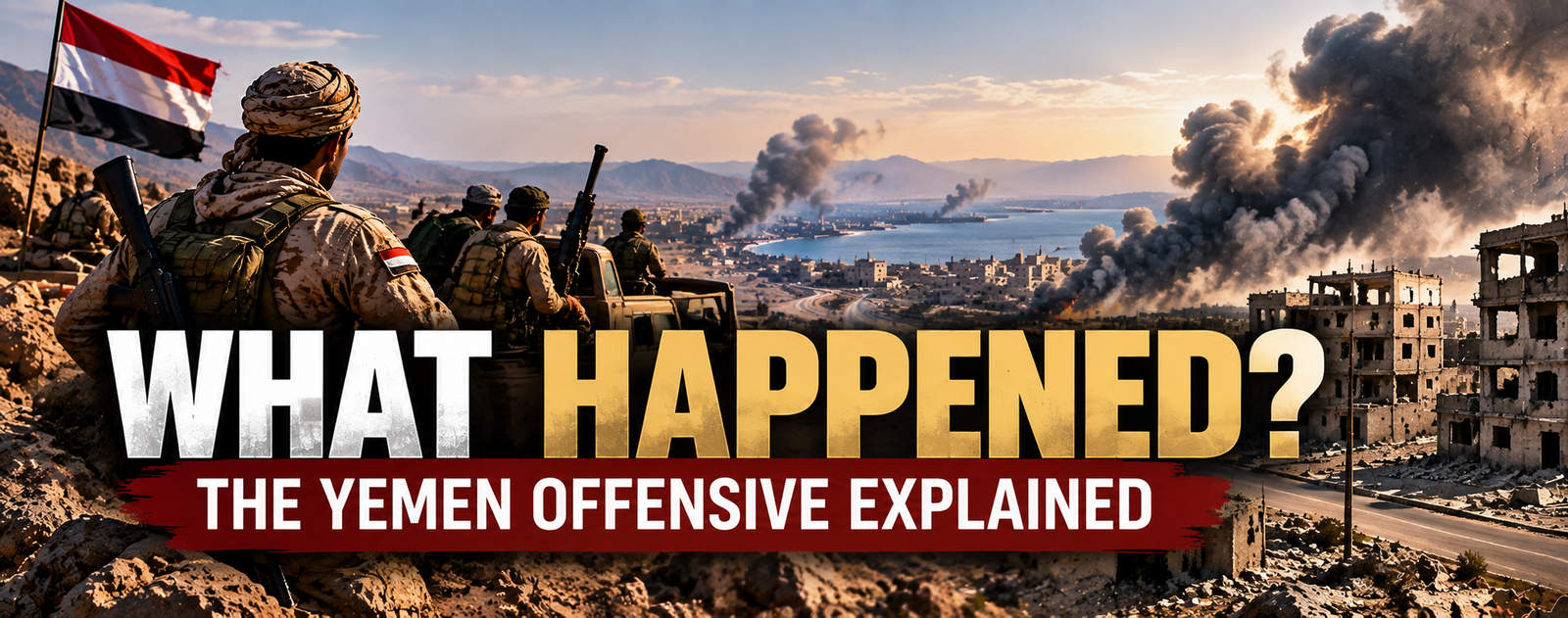
What Happened? The Yemen Offensive Explained
Why the Government Launched the Campaign
The current escalation followed significant Houthi territorial advances during the summer and early autumn of 2026.
The movement expanded along Yemen’s western coastline and threatened government positions around Taiz while gaining leverage over strategically important coastal routes. By early October, the internationally recognized government and Saudi Arabia had shifted from trying to contain those advances to attempting to reverse them.
On October 4, Presidential Leadership Council chairman Rashad al Alimi announced military operations intended to retake territory controlled by Ansar Allah, the formal name of the Houthi movement. Reuters reported that the declared objective was much broader than simply recovering a few coastal towns: the government publicly framed the campaign as a push to restore authority across Yemen. Reuters
That political objective is far more ambitious than what has yet been achieved militarily.
What Territory Has Changed Hands?
On October 5, government aligned forces reported rapid advances around Dhubab and the western coast. Yemen’s Defence Ministry also said Mocha had been recaptured.
Those claims are significant but should be reported carefully. Reuters has confirmed that a major government counteroffensive is taking place, but not every battlefield claim from either side has been independently verified. Fighting also continues in nearby areas. Reuters
The safest description is:
Saudi backed Yemeni government forces have regained substantial territory on the western front, but the wider battlefield remains fluid and contested.
That wording is more defensible than claiming that the government has decisively secured the entire region.
Yemen War Timeline: How the Latest Escalation Developed
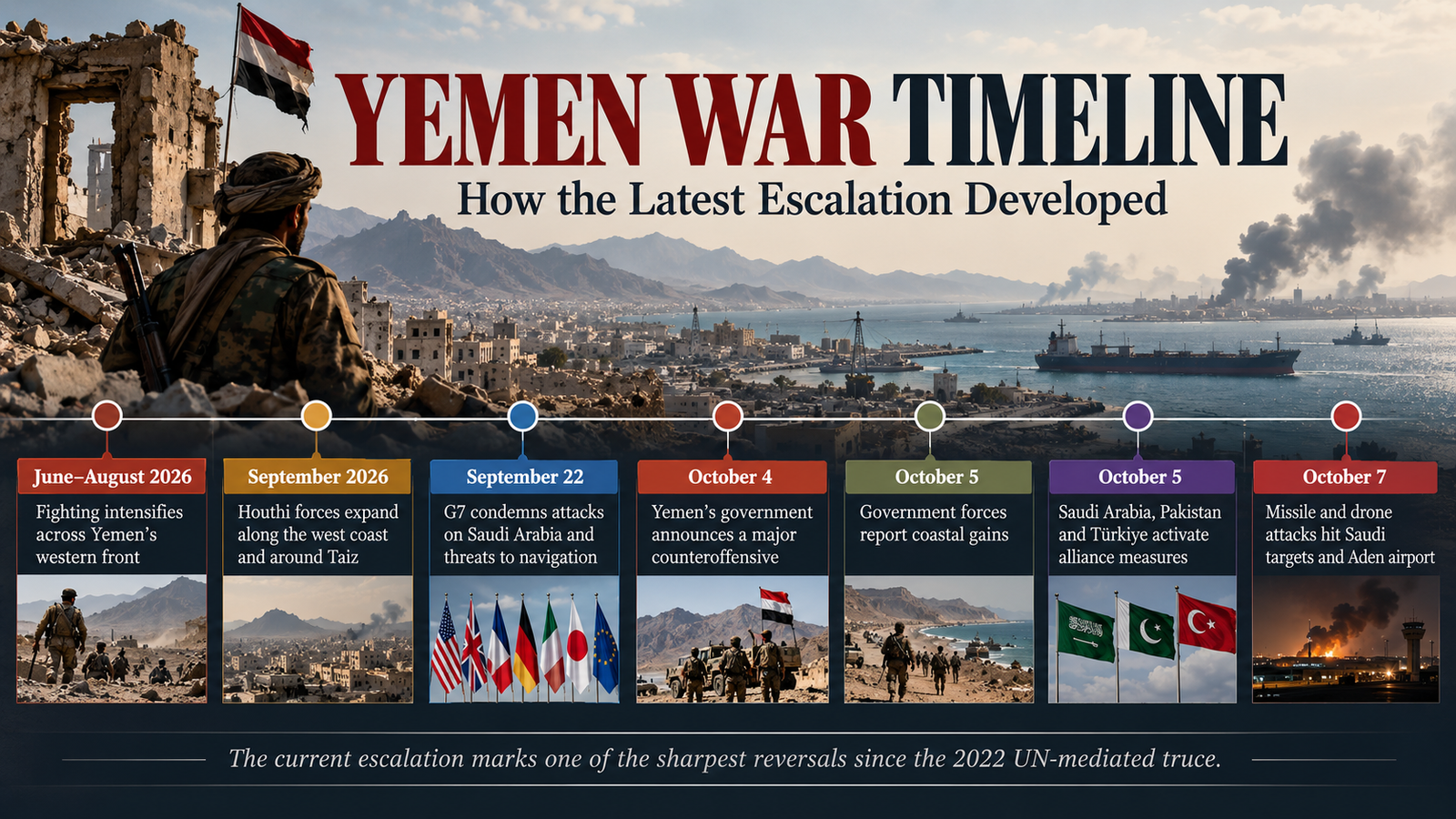
| Date | Development | Why it matters |
|---|---|---|
| June–August 2026 | Fighting intensifies across Yemen’s western front | Ends much of the relative calm that followed the 2022 truce |
| September 2026 | Houthi forces expand along the west coast and around Taiz | Raises pressure on government territory and Red Sea routes |
| September 22 | G7 condemns attacks on Saudi Arabia and threats to navigation | Shows growing international concern over the conflict’s global impact |
| October 4 | Yemen’s government announces a major counteroffensive | Marks a shift from containment to attempts to retake territory |
| October 5 | Government forces report coastal gains | Restores momentum to the anti-Houthi camp |
| October 5 | Saudi Arabia, Pakistan and Türkiye activate alliance measures | Introduces a new regional defence dimension |
| October 7 | Missile and drone attacks hit Saudi targets and Aden airport | Shows the conflict expanding beyond the ground front |
The escalation represents one of the most serious reversals of the relative military calm that followed the UN mediated truce of 2022. Dppa
Why Taiz Could Decide Whether the Offensive Succeeds
The Coast Is Only Part of the Battlefield
Attention naturally focuses on the Red Sea coast, but Taiz may be more important to the military outcome.
Government forces need secure roads, logistics routes and high ground linking coastal positions with forces inland. A rapid advance toward Mocha means little if supply lines remain vulnerable to counterattack.
The United Nations warned in September that fighting around Yemen’s western front and Taiz had already reached levels that made a return to large scale conflict a reality rather than a theoretical risk. UN Special Envoy Hans Grundberg has continued pushing the parties toward political off ramps rather than further escalation. Dppa
The Anti Houthi Side Is Not One Unified Army
Another weakness is command cohesion.
Government aligned formations include forces with different political affiliations, commanders and regional objectives. Some have historically received Saudi backing while others developed close links with the United Arab Emirates.
That means battlefield success does not automatically produce political unity.
The central question is not only:
Can government forces advance?
It is also:
Can they hold territory, coordinate command structures and agree on what postwar Yemen should look like?
Why Bab el Mandeb Still Matters
This article should mention Bab el Mandeb, but it should not become the primary subject because that deserves its own dedicated page.
The strait links the Gulf of Aden and Arabian Sea to the Red Sea and Suez route. Its importance comes not merely from who controls the coastline but from the ability of armed groups to threaten vessels with missiles, drones, mines or small craft.
U.S. Energy Information Administration data show oil flows through the strait rising to about 8.1 million barrels per day in the second quarter of 2026, up sharply from earlier periods. U.S. Energy Information Administration
That is why developments in Yemen can rapidly affect shipping insurance, freight rates, energy markets and supply chains well beyond the Middle East.
A separate Signature Views article can target Bab el Mandeb directly with shipping statistics, maps, trade routes and chokepoint analysis without competing with this article’s Yemen offensive focus.
Will Pakistan Join the Yemen Offensive?
What Pakistan Has Actually Agreed To
This is an area where the article must distinguish verified commitments from speculation.
Pakistan, Saudi Arabia and Türkiye signed the Makkah Joint Defence Agreement on August 7, 2026. Pakistan’s Foreign Ministry says the pact is defensive and provides that an armed attack against one of the three countries is regarded as an attack against all. Ministry of Foreign Affairs Pakistan
Following attacks against Saudi Arabia, the alliance’s Strategic Political and Defence Committee met in Riyadh on October 5.
The official joint statement says the three states agreed to provide agreed military forces and capabilities and ensure their rapid deployment “in the Kingdom”, meaning Saudi Arabia. Ministry of Foreign Affairs Pakistan
That distinction is critical.
| Question | Current verified position |
|---|---|
| Is Pakistan part of the defence alliance? | Yes |
| Has Pakistan agreed to help defend Saudi Arabia? | Yes |
| Can military forces/capabilities be deployed? | Yes, under agreed arrangements |
| Where does the official statement specify deployment? | Saudi Arabia |
| Has Pakistan announced troops fighting inside Yemen? | No verified public announcement |
| Could its role include air defence, intelligence or logistics? | Possible, but operational details have not been publicly confirmed |
The agreement also says implementation must follow the national legislation of each member state.
It would therefore be inaccurate at this stage to write that “Pakistan has entered the Yemen war.”
The better formulation is:
Pakistan has activated a collective defence commitment to Saudi Arabia while direct participation in offensive operations inside Yemen has not been confirmed.
Will Türkiye Send Forces?
Türkiye Has the Same Alliance Commitment but Different Legal Requirements
Türkiye participated in the October 5 committee meeting and signed the same collective defence decision.
The Turkish Foreign Ministry published the joint declaration confirming that agreed forces and capabilities are to be prepared for rapid deployment to Saudi Arabia, subject to national laws. Ministry of Foreign Affairs
However, the Financial Times reports that deployment of Turkish troops requires parliamentary ratification. Financial Times
That creates an important difference between political commitment and actual deployment.
Türkiye could potentially contribute capabilities such as air defence, drones, surveillance, logistics or training without deploying a large ground contingent into Yemen. Until Ankara announces specific operational measures, anything more detailed would be speculation.
What Does Saudi Arabia Want?
Saudi Arabia appears to have at least three overlapping requirements.
First, Riyadh wants to stop missile and drone attacks against Saudi territory, particularly attacks on airports, energy infrastructure and cities.
Second, it wants the internationally recognized Yemeni government to regain enough territory to prevent a hostile force from dominating the southwestern approaches to the Red Sea.
Third, Saudi leaders need a political outcome they can sustain. Riyadh spent years attempting to reduce its military exposure to the Yemen war. A permanent return to an open ended intervention would carry significant economic, security and reputational costs.
This suggests that the Yemen offensive could ultimately serve two functions: regain strategically important territory and improve Riyadh’s bargaining position in future negotiations.
How Is the World Reacting?
United States
Washington is supporting Saudi Arabia through intelligence and operational planning, but reporting indicates the U.S. has resisted requests for direct combat participation in the new campaign. Reuters
That reflects a balancing act: protect a major partner and shipping routes without becoming fully absorbed in another Middle Eastern war.
G7 and European Union
On September 22, G7 foreign ministers and the EU High Representative described the Yemen escalation as a threat to regional stability, global energy security and navigational freedoms. They condemned attacks against Saudi Arabia and commercial shipping while calling for a return to the political process. G7 Information Centre
The European Union separately expressed solidarity with Saudi Arabia and called for military escalation to end. EEAS
United Nations
The UN position is more focused on de escalation than military alignment.
Special Envoy Hans Grundberg warned in September that Yemen had entered a much more dangerous phase and urged all parties to preserve channels for negotiation, protect civilians and comply with international humanitarian law. Dppa
The UN Security Council is scheduled to hold further Yemen consultations on October 9, meaning diplomatic pressure is likely to increase if the battlefield continues expanding. United Nations
What Experts Think the Yemen Offensive Means
The most important analytical point is that territorial momentum and strategic victory are not the same thing.
Saudi backed forces can regain towns and transport corridors while still facing three structural problems:
- the Houthi movement retains substantial missile, drone and manpower capabilities;
- the anti Houthi coalition remains politically fragmented;
- and prolonged fighting increases civilian displacement and the risk of regional escalation.
AP’s current assessment likewise notes that Saudi Arabia appears to believe renewed military pressure may be necessary to push the movement toward negotiations, rather than assuming the conflict can simply be won through battlefield advances. AP News
The likely goal may therefore be coercive leverage, not necessarily immediate conquest of Sanaa.
What Could Happen Next?
| Scenario | What it would mean | Indicators to watch |
|---|---|---|
| Government consolidates gains | Coastal positions and supply routes remain under government control | Stable control around Mocha and western Taiz |
| Houthi counteroffensive | Lost positions are challenged or Saudi pressure increases | Missile launches, drone attacks, troop movements |
| Pakistan/Türkiye deepen support | Saudi territorial defence becomes more multinational | Official force announcements and deployment details |
| Wider regional escalation | Iran, Saudi Arabia and external powers increase involvement | New weapons flows or direct combat roles |
| Negotiations resume | Military pressure creates incentives for talks | UN, Omani or regional mediation |
| Long war resumes | Neither side can secure decisive advantage | Continuous multi front fighting and displacement |
The most dangerous outcome would be a shift from a primarily Yemeni conflict into a wider regional confrontation involving several treaty partners and external powers.
That outcome is possible, but not inevitable.
Humanitarian Impact: Civilians Are Already Paying the Price
The escalation is producing substantial displacement.
Between September 27 and October 3, IOM tracked 3,633 households, or 21,798 people, experiencing displacement. Most were displaced from or within Taiz. DTM IOM
From June through September 29, IOM’s separate West Coast escalation tracking recorded more than 152,000 displaced people, with Taiz accounting for more than half of those registered. DTM IOM
Those numbers matter because military reporting tends to describe territory as empty space.
It is not.
Every major offensive affects villages, roads, hospitals, fuel supplies, food access and families forced to move repeatedly.
What Should Civilians, Travelers and Businesses Do?
For people inside Yemen, conditions can change quickly. Avoid military bases, airports, ports, checkpoints and known front lines where possible. Follow recognized humanitarian and civil defence instructions rather than viral social media reports. Keep identity documents, essential medication, water, communications equipment and basic supplies accessible.
For international travelers, Yemen remains an extreme risk environment. Non essential travel should not be interpreted as safe merely because one side gains territory.
For shipping operators, current decisions should rely on UKMTO notifications, flag state requirements, company security officers and professional maritime risk assessments rather than media reports alone.
For businesses exposed to Red Sea trade, useful contingency measures include modelling Cape of Good Hope diversions, reviewing war risk insurance, tracking fuel and freight surcharges, assessing critical inventory and avoiding dependence on a single shipping route.
What to Watch Next
The next major indicators are control of western Taiz and Mocha, the scale of Houthi retaliation against Saudi Arabia, the exact military capabilities Pakistan and Türkiye deploy, any change in U.S. involvement, humanitarian displacement and the outcome of renewed UN diplomacy.
Frequently Asked Questions About the Yemen Offensive
Who is winning the Yemen offensive?
Government aligned forces have regained momentum and reported significant territorial gains, but the conflict remains contested. There is not enough verified evidence to describe the wider Yemen war as decisively turning in one side’s favour. Reuters
Are Pakistan and Türkiye joining the fighting in Yemen?
Not according to the verified public record so far. Both have activated collective defence commitments with Saudi Arabia, and agreed forces and capabilities may be deployed inside Saudi Arabia. Direct combat participation inside Yemen has not been publicly confirmed. Ministry of Foreign Affairs Pakistan
Why is Saudi Arabia involved?
Saudi Arabia backs Yemen’s internationally recognized government and is seeking to defend its territory against missile and drone attacks while reversing strategic gains by its adversaries.
What role does Bab el Mandeb play?
The strait is important because it connects the Red Sea with the Gulf of Aden and carries large volumes of global energy and commercial traffic. The fighting around it increases maritime risk even when the waterway itself remains open. U.S. Energy Information Administration
Is the Yemen war ending?
No. The latest escalation points in the opposite direction. Military activity has increased substantially, displacement is growing and the UN has warned that the risk of large scale conflict has returned. Dppa
About the Author