



Quick answer: Effective educational leadership is less about controlling people and more about creating the conditions in which teachers and students can flourish. Death Valley’s famous superbloom offers a powerful metaphor: potential can remain dormant for years until the environment changes. For schools, those conditions include trust, psychological safety, autonomy, personalization and a strong culture of belonging.
Stop Managing Schools Like Factories: 5 Educational Leadership Lessons from Death Valley’s Superbloom

See More
In spring 2005, one of the driest landscapes in North America did something extraordinary.
Death Valley erupted in wildflowers.
The National Park Service identifies 2005 as one of the park’s exceptional superbloom years. Such blooms require more than one dramatic storm. They depend on well-timed rainfall, suitable temperatures and favorable growing conditions over time. National Park Service
For months and sometimes years, wildflower seeds can remain beneath the desert surface.
Then the conditions change.
What appeared barren turns out to have been full of unrealized potential.
Sir Ken Robinson famously used Death Valley as a metaphor for education in his TED Talk How to Escape Education’s Death Valley. His argument was simple but powerful: human beings are not mechanical systems. People flourish under particular conditions, and leadership has an important role in creating those conditions. TED
That idea has major implications for educational leadership.
When a school struggles, leaders often respond by adding rules, monitoring, scripts, targets or standardized interventions.
Sometimes those tools are necessary.
But they can also address the visible symptoms while ignoring the environment producing them.
A disengaged student may not lack ability.
A frustrated teacher may not lack commitment.
A stagnant department may not lack talent.
The missing ingredient may be the conditions under which that potential can emerge.
The central leadership question therefore becomes:
Are we managing schools like machines, or cultivating them like living systems?
Educational Leadership Lesson 1: Stop Managing Schools Like Factories
For much of modern educational history, schools have often been organized around industrial principles.
Students are grouped by age. Time is divided into fixed periods. Subjects are separated. Performance is measured against common standards. Leaders monitor targets, schedules, compliance and outputs.
There are practical reasons for some of this structure.
Schools need timetables, standards, safeguarding, accountability and reliable systems.
The problem begins when leaders assume that people behave like production units.
Learning is not manufacturing.
You cannot simply increase student curiosity by issuing an instruction.
You cannot order a teacher to become creative.
You cannot schedule genuine engagement into existence.
That is why the factory metaphor is increasingly limited.
A better metaphor for school leadership is the ecosystem.
An ecosystem has structure, but it also contains diversity, relationships, feedback loops and adaptation.
A successful school leader therefore does more than manage processes.
The leader influences the conditions in which people work and learn.
What does ecosystem leadership look like?
It means asking:
- Do teachers have the resources required to do good work?
- Are expectations clear without becoming unnecessarily restrictive?
- Can staff raise concerns without fear?
- Do students have meaningful choices?
- Are mistakes treated as evidence for improvement?
- Is professional expertise trusted?
- Are different talents recognized?
- Does the timetable support learning or merely administrative convenience?
This is not an argument against standards.
It is an argument against confusing standardization with quality.
Educational Leadership Lesson 2: Assume Talent Is Abundant
One of the strongest ideas in the Death Valley metaphor is that the desert was never empty.
The seeds were already there.
For leaders, this creates a radically different starting assumption.
Traditional deficit thinking asks:
What is wrong with these students?
Why are these teachers resistant?
Why is this department underperforming?
A developmental leadership approach asks instead:
What conditions are preventing existing capability from emerging?
That shift changes how problems are diagnosed.
For teachers
When staff appear disengaged, the immediate response should not automatically be tighter supervision.
Leaders should examine whether teachers face:
- excessive administrative work
- unclear priorities
- insufficient planning time
- constant initiative changes
- lack of decision-making authority
- poor communication
- fear of criticism
- inadequate professional support
Research and practitioner guidance consistently connect teacher autonomy, collaborative leadership and meaningful involvement in decisions with stronger engagement and ownership. Edutopia
The leadership question therefore becomes:
What obstacles can we remove so competent teachers can do their best work?
For students
The same principle applies to children.
A student who performs poorly in a traditional lecture may flourish in:
- project-based work
- debate
- visual design
- coding
- music
- entrepreneurship
- practical engineering
- collaborative problem solving
- vocational learning
Disengagement should not automatically be interpreted as lack of intelligence.
Sometimes it is evidence of a poor match between the learner and the environment.
Educational Leadership Lesson 3: Replace Excessive Standardization with Intelligent Personalization
A superbloom is not impressive because every flower is identical.
Its beauty comes from variation.
Schools often struggle with this idea.
Systems need common expectations, but human beings do not develop in identical ways or at identical speeds.
That is why effective educational leadership must distinguish between:
common standards
and
identical pathways.
Students can work toward meaningful academic goals while having different routes for reaching them.
Personalized learning seeks to adapt aspects of the learning environment to students’ needs, interests and abilities. Well-designed personalization can also increase ownership and engagement, but it still depends on strong teaching rather than simply adding technology. Edutopia
Personalization does not mean lowering standards
This distinction is important.
Customization should not mean:
“Every student does whatever they want.”
It means giving students different ways to engage with rigorous learning.
For example, a class studying climate change might allow students to demonstrate understanding through:
- a research report
- a data analysis
- a presentation
- a policy proposal
- a documentary
- a scientific model
The learning objective can remain demanding even when the route differs.
Teacher autonomy matters too
Personalization also requires teachers to have enough professional flexibility to respond to the students actually sitting in front of them.
A rigid script designed hundreds of miles away cannot anticipate every classroom.
Strong leaders therefore establish clear goals while leaving room for professional judgment.
Educational Leadership Lesson 4: Build Psychological Safety
If the Death Valley metaphor requires a form of educational “rain,” psychological safety is one of its strongest equivalents.
Psychological safety means people believe they can speak, ask questions, admit uncertainty, suggest ideas and make reasonable mistakes without being humiliated or punished.
In schools, that principle matters for both adults and students.
Edutopia describes psychological safety among educators as the perception that people feel supported and able to take interpersonal risks, express opinions and share ideas. Edutopia
ASCD similarly connects psychologically safe schools with leaders creating environments where educators can learn and adapt without excessive fear. ASCD
What fear does to a school
A fear-driven culture can produce compliance.
It rarely produces innovation.
If teachers believe every experiment could damage their evaluation, they will choose the safest possible instruction.
If students believe every wrong answer will embarrass them, they will stop volunteering answers.
If middle leaders fear challenging senior leadership, problems remain hidden.
In each case, the organization may appear orderly while becoming less capable of learning.
What psychologically safe leaders do
They:
- admit when they do not know something
- distinguish honest mistakes from negligence
- invite dissent
- ask staff for input before major changes
- respond constructively to bad news
- avoid humiliating people publicly
- provide predictable expectations
- make experimentation safe within clear boundaries
Recent school leadership guidance also emphasizes that psychological safety is strengthened through inclusive communication, predictable structures and a culture in which staff members feel seen and heard. Edutopia
This does not eliminate accountability.
Psychological safety and high expectations can coexist.
In fact, they often need each other.
Educational Leadership Lesson 5: Create Autonomy Without Removing Structure
There is an important danger in the ecosystem metaphor.
A school cannot simply remove every rule and hope creativity appears.
Gardens still require structure.
So do schools.
The strongest learning environments tend to combine clear expectations with meaningful autonomy.
Research-oriented educational guidance suggests that controlling classrooms can reduce autonomy and motivation, while environments supporting autonomy, competence and relationships can improve engagement. Edutopia
The objective is therefore not:
control or freedom
but:
structured freedom.
Students should know what success looks like while retaining some influence over how they reach it.
Teachers should understand institutional expectations while retaining professional judgment over how they teach.
Departments should have common goals while being able to adapt their methods.
That balance is one of the most difficult tasks in educational leadership.
The Superbloom Leadership Model
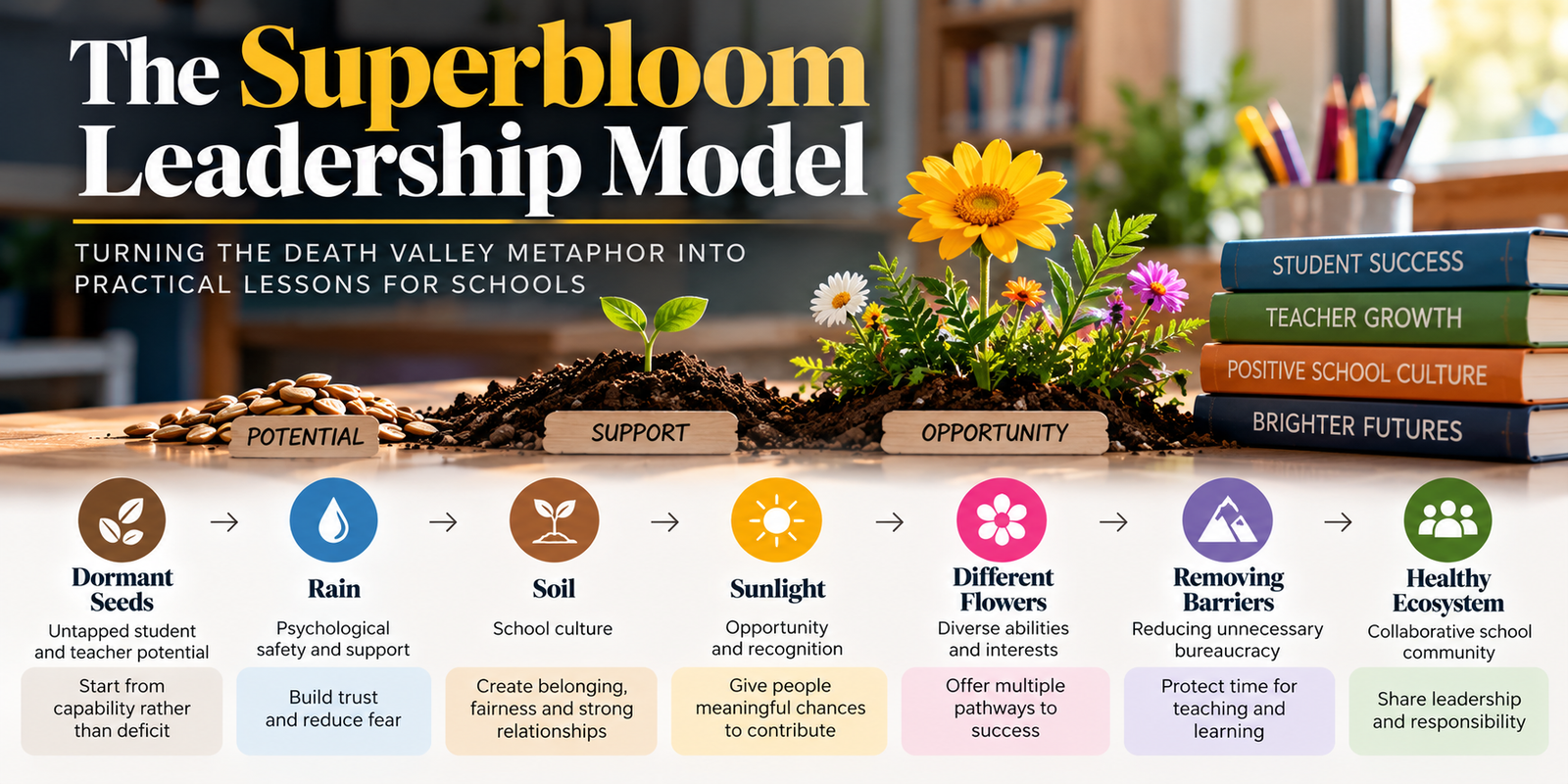
The Death Valley metaphor can be turned into a practical framework.
| Superbloom condition | School equivalent | Leadership action |
|---|---|---|
| Dormant seeds | Untapped student and teacher potential | Start from capability rather than deficit |
| Rain | Psychological safety and support | Build trust and reduce fear |
| Soil | School culture | Create belonging, fairness and strong relationships |
| Sunlight | Opportunity and recognition | Give people meaningful chances to contribute |
| Different flowers | Diverse abilities and interests | Offer multiple pathways to success |
| Removing barriers | Reducing unnecessary bureaucracy | Protect time for teaching and learning |
| Healthy ecosystem | Collaborative school community | Share leadership and responsibility |
This gives the metaphor operational value rather than leaving it as an inspirational story.
Why School Culture Matters More Than Another Initiative

Schools frequently respond to problems by adding programs.
A new intervention.
A new platform.
A new behavior system.
A new assessment framework.
A new professional development initiative.
But a program placed inside a weak culture may simply become another burden.
School culture influences whether teachers collaborate, whether students feel respected and whether change efforts survive beyond their launch.
Educational guidance on school culture emphasizes the importance of systematically creating supportive climates rather than assuming culture will improve by itself. Edutopia
Before launching the next initiative, leaders should therefore ask:
What is the current climate into which we are introducing it?
If trust is low, even a good reform can be interpreted as surveillance.
If staff are exhausted, another innovation may feel like punishment.
If students feel unheard, another engagement program may appear superficial.
Conditions come first.
Student Agency Is Part of the Climate
The superbloom principle also applies directly to students.
Students are more likely to engage deeply when they have meaningful ownership of learning.
That can involve:
- choosing topics
- selecting project formats
- participating in classroom discussion
- setting goals
- reflecting on progress
- helping establish classroom norms
Student agency does not diminish the importance of teachers.
It changes their role.
Strong teachers become designers of learning environments in which students gradually take greater responsibility.
Edutopia notes that giving students more control and opportunities to assess their own progress can support independence and metacognition. Edutopia
Other guidance similarly links student choice with greater agency and engagement. Edutopia
What Educational Leaders Can Do This Week
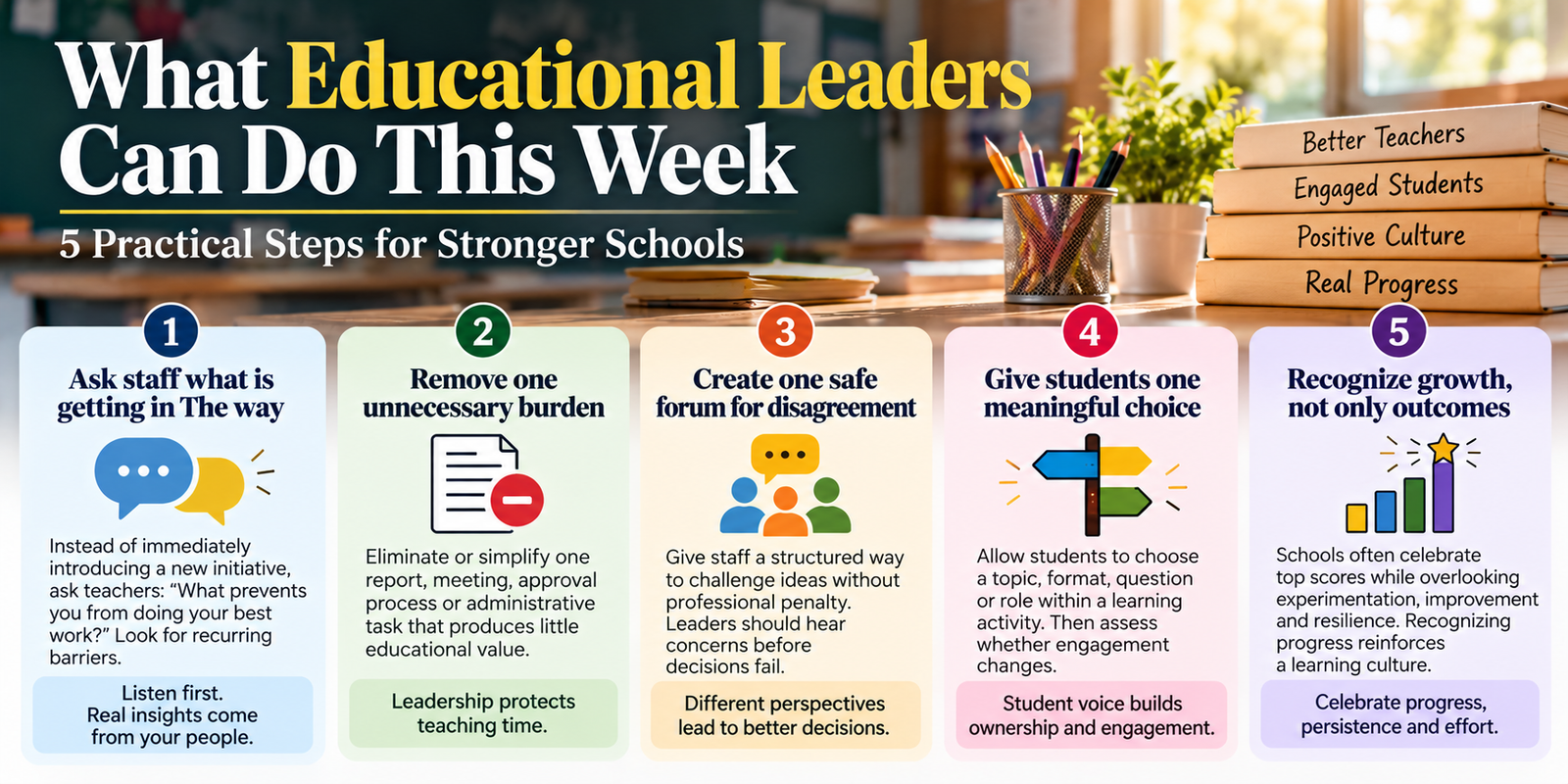
A useful leadership philosophy must eventually become behavior.
School leaders can begin with five practical steps.
1. Ask staff what is getting in the way
Instead of immediately introducing a new initiative, ask teachers:
What prevents you from doing your best work?
Look for recurring barriers.
2. Remove one unnecessary burden
Eliminate or simplify one report, meeting, approval process or administrative task that produces little educational value.
This communicates something important:
leadership protects teaching time.
3. Create one safe forum for disagreement
Give staff a structured way to challenge ideas without professional penalty.
Leaders should hear concerns before decisions fail.
4. Give students one meaningful choice
Allow students to choose a topic, format, question or role within a learning activity.
Then assess whether engagement changes.
5. Recognize growth, not only outcomes
Schools often celebrate top scores while overlooking experimentation, improvement and resilience.
Recognizing progress reinforces a learning culture.
What This Approach Does Not Mean
The “schools are ecosystems” argument can easily be misunderstood.
It does not mean:
- abandoning academic standards
- eliminating assessment
- removing accountability
- accepting poor performance
- allowing classrooms to become chaotic
- assuming every educational problem can be solved by kindness
Healthy ecosystems still require boundaries.
Effective schools still need curriculum, evaluation, discipline, safeguarding and leadership.
The distinction is about how those systems are used.
Control should serve learning.
Learning should not exist merely to serve the control system.
The Bottom Line: Change the Conditions Before Blaming the People
Death Valley’s superbloom offers educational leaders a useful warning.
A barren surface does not necessarily mean the absence of life.
It may mean the environment has not allowed that life to emerge.
The same principle applies to schools.
A disengaged classroom may contain enormous curiosity.
A cynical staff room may contain enormous professional expertise.
A struggling student may possess abilities that the current system rarely asks them to use.
Leadership cannot manufacture those qualities.
It can create conditions that allow them to appear.
That requires trust without complacency, autonomy without chaos, personalization without abandoning standards, and accountability without fear.
The strongest educational leaders therefore do not ask only:
How do I make people perform?
They also ask:
What conditions would allow these people to flourish?
That is the deeper lesson of the superbloom.
The potential may already be there.
The leader’s job is to make sure the climate allows it to grow.
Frequently Asked Questions About Educational Leadership
What is educational leadership?
Educational leadership is the practice of guiding schools, teachers and learning communities toward better educational outcomes through strategy, culture, professional development, decision making and support.
What is the difference between school management and educational leadership?
School management focuses heavily on operations such as schedules, staffing, policies and resources. Educational leadership includes those responsibilities but places greater emphasis on learning, culture, people, improvement and long-term direction.
Why is psychological safety important in schools?
Psychological safety helps teachers and students ask questions, share ideas, acknowledge mistakes and take reasonable intellectual risks without excessive fear of embarrassment or punishment. Edutopia
How can school leaders motivate teachers?
Leaders can support motivation by creating clarity, providing resources, protecting professional autonomy, involving teachers in decisions, reducing unnecessary workload and building a culture of trust and recognition. Edutopia
What is student agency?
Student agency refers to learners having meaningful influence over aspects of their learning, including choices, goals, reflection and participation in decisions.
Does personalized learning mean every student gets a different curriculum?
No. Personalized learning can maintain common academic expectations while adapting methods, pace, activities or demonstrations of learning to student needs and interests.
What did Ken Robinson say about Death Valley?
Robinson used Death Valley’s transformation after rainfall as a metaphor for human potential. His broader argument was that people flourish when institutions create the appropriate conditions for growth. TED
About the Author