

By Dr. Atique Ur Rehman
Quick answer: Governance issues in Pakistan cannot be explained by one shortage, one institution or one political cycle. They involve how decisions are made, how institutions receive information, how citizens determine what is credible, how technology shapes attention, and whether people believe effort can produce results. Across ten books, I have explored these problems from different directions. Together, they form one argument: sustainable reform requires better institutions, better information and a different relationship between citizens, technology and the state.
Why do governance issues in Pakistan persist even when reforms look convincing on paper?
See More
Pakistan has educated people, natural resources, elections, universities, entrepreneurs and a large young population.
The question is not merely rhetorical.
The World Bank’s 2025 Worldwide Governance Indicators gave Pakistan a government-effectiveness score of 39.9 out of 100. The indicator reflects perceptions of public-service quality, the civil service, policy formulation, implementation and government credibility. The World Bank also cautions that these are perception-based estimates rather than definitive grades of government performance.
Pakistan is not standing still. Reform efforts continue. UNDP’s current governance work in Pakistan emphasizes civil-service capacity, institutional reform, adaptive management and embedding changes deeply enough that they become part of ordinary government practice rather than temporary projects.
So why does the gap between reform announced and reform experienced remain so difficult to close?
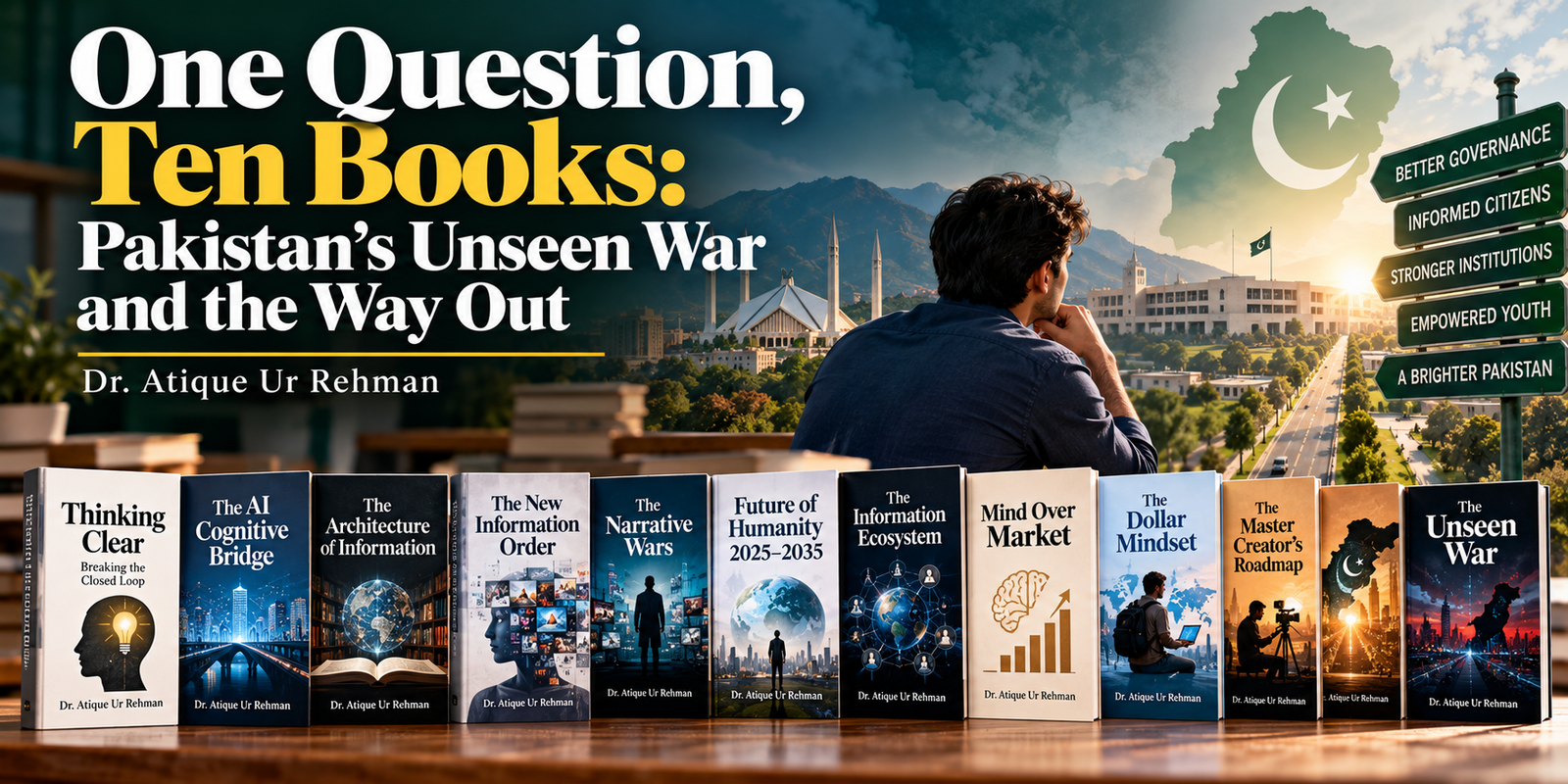
That question has followed me through ten books.
Each book looks at a different layer of the problem. Taken together, they describe what I call Pakistan’s unseen war: a struggle over thinking, information, trust, institutional capability and the choices citizens and leaders make before visible policy outcomes ever appear.
1. Thinking Clear: Governance Reform Begins Before Policy
My book Thinking Clear begins with a proposition:
Institutional outcomes are partly shaped by the habits of thought that precede institutional decisions.
Within the book, I identify five recurring tendencies:
- extracting value rather than building it
- prioritizing the immediate over the long term
- surrendering agency to fate
- preferring patronage and connections over merit
- becoming accustomed to dysfunction
I bring these tendencies together in a framework I call the Closed Loop.
Weak assumptions produce weak decisions.
Weak decisions create poor outcomes.
Repeated poor outcomes create disappointment and fatalism.
Fatalism then reinforces the assumptions that helped produce the poor decisions.
The result is a self-reinforcing cycle.
This framework should not be read as an argument that Governance issues in Pakistan exist simply because citizens “think incorrectly.” Governance is institutional, economic, legal and political.
The argument is narrower.
Reform becomes harder when institutions and citizens repeatedly adapt themselves to dysfunction instead of challenging the assumptions that sustain it.
Breaking a loop therefore requires more than rewriting a regulation.
It requires changing incentives, expectations and behavior at the same time.
2. The AI Cognitive Bridge: Pakistan Has a Feedback Problem
One of the most important Governance issues in Pakistan is the distance between people who design policy and people who experience its consequences.
There are, metaphorically, two Pakistans.
One exists inside files, dashboards, presentations and official summaries.
The other exists in schools, hospitals, police stations, district offices, villages, markets and households.
The problem is not necessarily bad intent.
It is information loss.
Every bureaucratic layer can compress, reinterpret or sanitize reality before it reaches senior decision-makers.
My book The AI Cognitive Bridge proposes using artificial intelligence to narrow this gap.
The idea is not AI surveillance.
It is AI-assisted institutional listening.
Citizen complaints, public-service data, field reports and recurring local problems could be aggregated and analyzed so that decision-makers see patterns that are otherwise buried inside administrative systems.
But such a model would require strong safeguards.
Its principles include privacy, institutional independence, transparent methodology, limits on individual surveillance and strong domestic control over sensitive public data.
This question is increasingly practical rather than theoretical.
Pakistan’s National Artificial Intelligence Policy was approved on July 31, 2025. Among other goals, the policy calls for AI infrastructure, responsible-use mechanisms and national-scale civic and social AI projects.
Pakistan’s National AI Policy was approved in 2025 and provides an official framework for AI infrastructure, innovation and responsible adoption. Pakistan National AI Policy
The challenge is therefore no longer simply:
Will Pakistan use AI?
It is:
What kind of institutional relationship with AI will Pakistan build?
3. The Architecture of Information: Information Is Not Knowledge
Technology cannot improve governance if the information entering the system is unreliable.
That leads to the argument of The Architecture of Information.
Information and knowledge are not identical.
A society may possess enormous quantities of information while becoming less certain about what is true.
Knowledge depends on processes that establish credibility.
Courts authenticate evidence.
Scientific institutions test hypotheses.
Statistical organizations establish measurement standards.
Professional journalism verifies sources.
Auditors check accounts.
Universities examine claims.
Citizens cannot personally verify every fact on which modern life depends. They therefore rely on institutions of verification.
When those institutions lose trust, the problem is much larger than disagreement.
The society loses part of the machinery that converts information into usable knowledge.
Pakistan’s information environment is expanding rapidly
Pakistan had an estimated 117 million internet users in late 2025 and roughly 79.9 million social-media user identities, according to DataReportal’s Digital 2026 analysis. Those figures come with methodological caveats, but they demonstrate the enormous scale at which information now moves through Pakistan.
The scarcity is no longer simply access to information.
Increasingly, the scarcity is credible attention.
I describe the resulting condition as information obesity: consuming more information than we have the time or capacity to verify, interpret and integrate.
A society can therefore become information-rich while remaining knowledge-poor.
4. The New Information Order: When Information Becomes a Weapon
The New Information Order takes the argument further.
Pakistan’s information environment has changed faster than many of its social institutions.
Short-form video, algorithmic recommendation, generative AI and instant messaging now allow claims to reach millions of people before institutions have established whether those claims are true.
This does not mean social media users are uniquely irrational.
It means the architecture has changed.
Many digital systems reward engagement, speed and emotional response. Verification often arrives later.
The consequence is a struggle not merely over information, but over attention and credibility.
The House of Glass
One framework I use is the House of Glass.
A person may feel surrounded by unlimited information while remaining unable to see the systems determining what appears on the screen.
The walls are transparent.
That does not mean they are absent.
Recommendation systems, platform incentives, social networks and personal behavior all influence the informational environment.
The Liar’s Dividend
Another important phenomenon is the Liar’s Dividend.
Unlike some of the frameworks in my books, this is an established concept in deepfake scholarship.
Robert Chesney and Danielle Citron described how widespread awareness of synthetic media can produce a second danger: genuine recordings can be dismissed as fake simply because convincing fakes are known to exist. Later research has found evidence that public figures can sometimes benefit from falsely claiming authentic information is fabricated.
That changes the problem fundamentally.
The danger is no longer only:
Will people believe a fake?
It becomes:
Will people believe anything?
Pakistan is already confronting the wider misinformation challenge. UNDP’s iVerify Pakistan initiative reported that, among 513 stories it fact-checked between December 2023 and November 2025, 78.2 percent were assessed as false and 19.7 percent as misleading. UNDP also reported increasing use of AI-enabled manipulation, including fabricated speeches and altered visuals.
That does not mean those percentages represent all information circulating in Pakistan. They describe the suspicious claims selected for verification.
But they illustrate the scale of the verification challenge.
5. The Narrative Wars: Information Conflict Becomes Human
Statistics explain misinformation.
Stories reveal what it feels like.
My novel The Narrative Wars transforms the information struggle into fiction.
Its central premise is that narratives do not stay inside phones.
They alter relationships.
They change reputations.
They affect institutions.
They can influence what communities fear, whom citizens trust and what governments feel compelled to respond to.
In that world, truth itself becomes strategically important.
The novel asks what happens when the information environment becomes so contested that discovering what happened is only half the battle.
The other half is persuading people that reality still deserves to be believed.
6. Future of Humanity 2025-2035: The Decade of Institutional Choice
Future of Humanity 2025-2035 puts these issues on a timeline.
Its central thesis is that the years between 2025 and 2035 represent a period of unusually consequential technological and institutional change.
Three forces are converging:
rapid technology, institutional stress and public anxiety.
Within the book, I argue that 2025 to 2030 is a particularly important window for establishing AI rules and institutions.
That date range should be understood as my strategic thesis, not as a scientific deadline after which AI governance becomes literally impossible.
The underlying point is that institutional choices become harder to reverse after technologies are deeply embedded in everyday systems.
Pakistan’s adoption of a National AI Policy in 2025 demonstrates that the country has already entered this governance phase.
The book’s message, however, is not fatalistic.
Direction is not destiny.
Knowing where a road appears to lead gives societies an opportunity to alter course.
7. The Information Ecosystem: Institutions Spend Trust They Earned Earlier
Governments are not the only institutions facing this challenge.
Companies, universities, media organizations, NGOs and public agencies now operate inside the same contested information environment.
The Information Ecosystem examines how organizations build authority and maintain credibility when synthetic content is cheap and attention is fragmented.
Its central rule is simple:
In a crisis, an institution can spend only the credibility it earned before the crisis began.
Trust cannot be manufactured in the hour it becomes necessary.
If an organization has repeatedly exaggerated claims, hidden mistakes or communicated selectively, a perfect press release will not suddenly create credibility when a crisis arrives.
Reputation is therefore an accumulated institutional asset.
That makes transparency, verification and consistency operational issues rather than merely communication principles.
8. Mind Over Market: Markets Are Information Systems Too
Mind Over Market applies the same argument to commerce.
Businesses often mistake visibility for persuasion.
More advertising.
More content.
More impressions.
More posts.
But markets are not won simply by increasing noise.
Customers interpret offers through psychology, trust, story, positioning and past experience.
They do not buy because a company announces that it is excellent.
They buy because they believe a product or service solves a problem they actually have.
This mirrors the broader information argument.
Volume does not automatically create meaning.
A company that understands the customer’s problem can outperform one producing vastly more content without understanding why anyone should care.
9. The Dollar Mindset: A Personal Exit from Patronage
National reform is slow.
Young people cannot suspend their lives while waiting for institutions to improve.
That is the starting point of The Dollar Mindset.
The book examines AI-enabled freelancing, remote work and global digital markets as pathways through which Pakistani professionals can sell skills internationally.
Its deeper argument is psychological.
Imagine a young Pakistani completing a project for a client thousands of kilometers away.
The client does not know the worker’s family.
There is no political recommendation.
No relative made a phone call.
No local patron arranged the opportunity.
The transaction happens because someone needed a capability and another person demonstrated it.
That experience challenges three components of the Closed Loop simultaneously:
patronage, fatalism and extraction.
It demonstrates that capability itself can create opportunity.
The model is not a substitute for national economic reform. Not every worker can immediately access international markets, and digital work has its own risks and inequalities.
But it can give individuals greater agency while larger institutional reforms develop.
10. The Master Creator’s Roadmap: Let the Machine Be the Engine
The Master Creator’s Roadmap applies a similar principle to creators.
Artificial intelligence can dramatically increase production speed.
But speed does not eliminate the need for judgment.
The principle I use is:
let the machine be the engine, but keep the human as the pilot.
AI can research, organize, edit, generate alternatives and automate repetitive work.
Human beings must still determine purpose, credibility, taste, ethics and meaning.
That distinction becomes increasingly important as synthetic content expands.
The competitive advantage of the future may not belong to the person who produces the most.
It may belong to the person who knows what deserves to be produced at all.
The Unseen War: Bringing the Ten Books Together
All of these arguments converge in The Unseen War.
The book follows four Pakistanis experiencing the same national problems from very different positions:
an unemployed graduate, a federal secretary, a village teacher and a retired state communications officer.
Their experiences connect the individual to the institution.
The book then proposes ten national decisions, each linked to responsibility and a deadline, and explores three possible Pakistans in 2035.
The purpose is to move the argument from diagnosis to choice.
Because Pakistan does not lack diagnoses.
Reports have documented problems in governance, education , human capital and institutional effectiveness for years.
For example, World Bank reporting estimates that roughly 78 percent of Pakistani 10-year-olds cannot read and understand an age-appropriate text, while around one quarter of primary-school-aged children are out of school. The World Bank’s Worldwide Governance Indicators track dimensions including government effectiveness, regulatory quality, rule of law and control of corruption. World Bank Worldwide Governance Indicators
The educational dimension is especially important.
In From Purposeless to Purposeful: Educational Transformation in Pakistan, I argue that Pakistan’s education system needs to shift from memorization toward reasoning, questioning, connection and application.
That matters because the information war cannot be solved only by regulating platforms. It also requires citizens capable of evaluating what those platforms show them.
The challenge is converting knowledge into institutional behavior.
That is the thread connecting all ten books.
The Framework in One View

| Stage | Book | Core question | Response |
|---|---|---|---|
| Thinking | Thinking Clear | Why do dysfunctional patterns repeat? | Break the Closed Loop |
| Government feedback | The AI Cognitive Bridge | Why does ground reality fail to reach decision-makers? | Build secure, transparent feedback systems |
| Knowledge | The Architecture of Information | How does information become trustworthy knowledge? | Strengthen verification and institutional trust |
| Information conflict | The New Information Order | How do platforms and synthetic media change reality? | Build epistemic resilience |
| Narrative | The Narrative Wars | What happens when information conflict reaches ordinary lives? | Understand narrative power |
| Future governance | Future of Humanity 2025-2035 | When should AI rules be established? | Govern before dependency hardens |
| Institutions | The Information Ecosystem | How is credibility built? | Earn trust before crisis |
| Markets | Mind Over Market | Why does noise fail to persuade? | Build around human problems and trust |
| Youth opportunity | The Dollar Mindset | How can individuals gain agency now? | Compete through skill in global markets |
| Creation | The Master Creator’s Roadmap | What should humans do when machines become fast? | Use AI for speed while retaining judgment |
What Governance Reform in Pakistan Requires
The argument across these books does not reduce governance issues in Pakistan to one villain or one institution.
It suggests several layers must move together.
Public institutions need better feedback.
Citizens need stronger verification habits.
Leaders need reliable information rather than comforting information.
AI needs governance before dependency becomes difficult to unwind.
Young people need pathways in which capability can matter more than connections.
Businesses and institutions need to treat credibility as an asset.
And citizens need to reclaim one of the smallest but most consequential decisions in the information age:
whether to share something before verifying it.
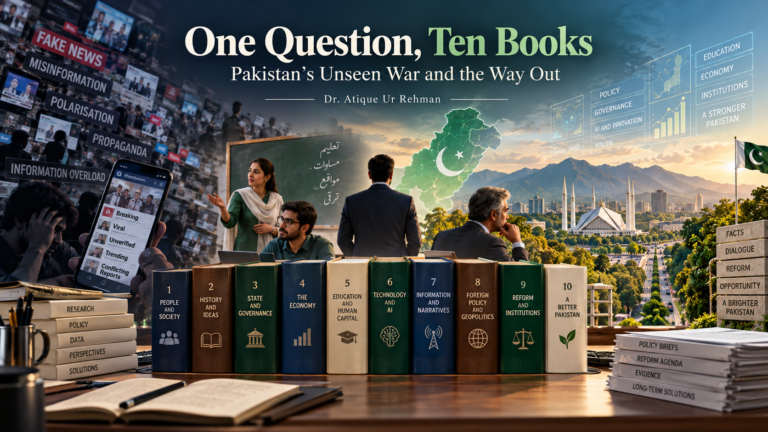
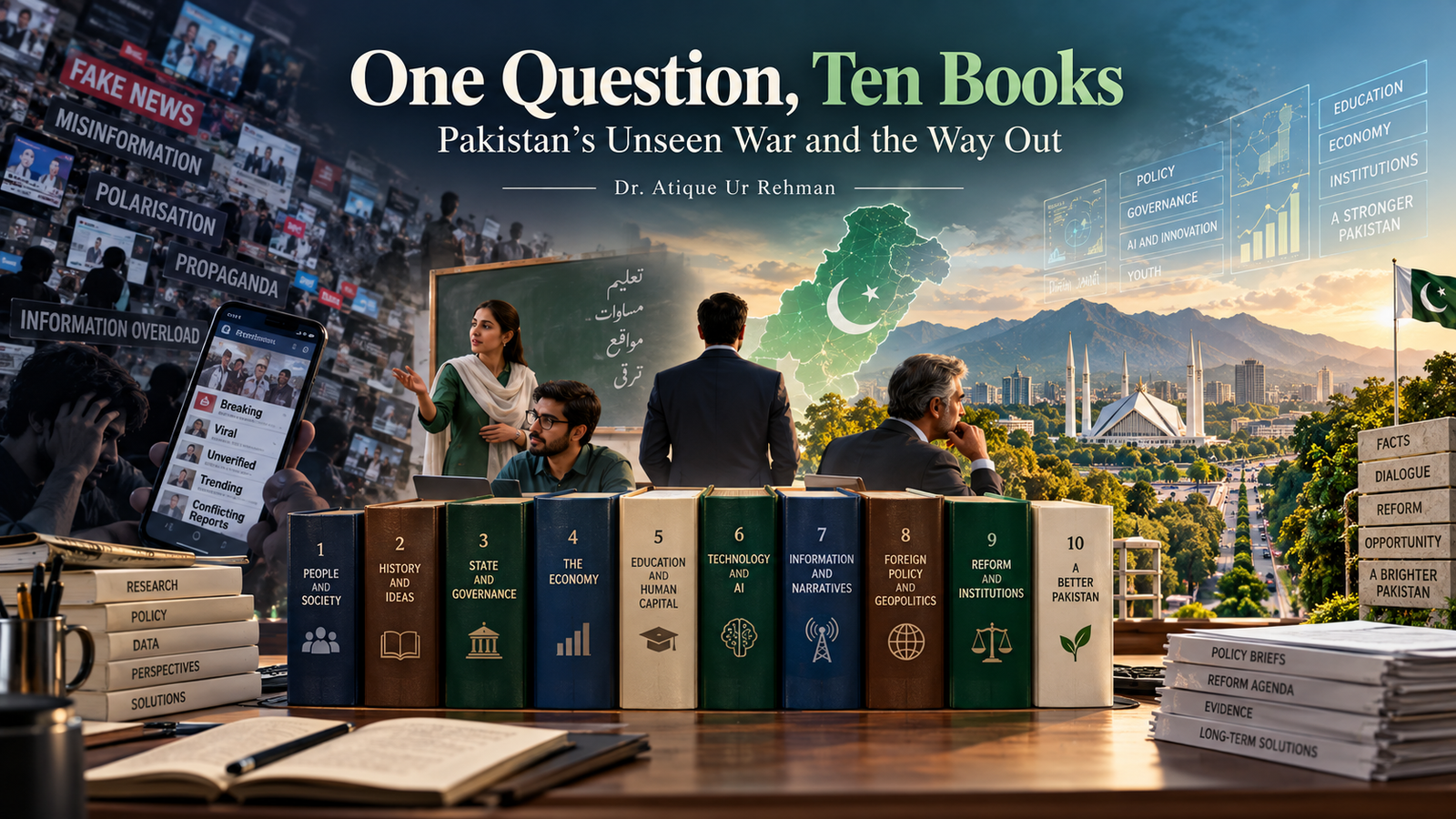
One Question, Ten Books, One Choice
More By Dr Atique
All ten books return to the same question:
Why does a country with talent, resources and ambition continue struggling to turn potential into reliable institutional performance?
My answer has evolved across the books.
It begins with thought.
Then information.
Then trust.
Then institutions.
Then technology.
Then individual agency.
And finally, national choice.
Pakistan’s future will not be determined by one book, one technology, one government or one reform program.
But every system eventually depends on millions of smaller decisions.
What information do we trust?
What evidence do we check?
What behavior do institutions reward?
What do young people believe is possible?
What responsibilities do leaders accept?
And what do ordinary citizens do when a provocative video reaches their phone?
The message connecting all of my work is therefore simple:
We cannot control the volume of falsehood around us, but we can control our response to it. Credibility defeats noise.
Sometimes the first act of reform is remarkably small.
A thumb stops.
A person does not immediately press share.
Instead, they ask:
Who made this?
That pause will not solve Governance issues in Pakistan by itself.
But a society capable of pausing, checking, questioning and acting on credible information is far better equipped to solve them.
This is also why understanding the origin of information matters.
In The Narrative Ladder: How Lies Become News, I examine how a claim can begin on a small blog, Telegram channel or social-media account, move through mid-level outlets, and eventually acquire the appearance of authority simply because it has been repeated.
Repetition is not verification.
But in an overloaded information environment, the two can easily be confused.
Explore the Books
All books by Dr. Atique Ur Rehman are available through his Gumroad catalogue.
The Unseen War brings the wider argument together through four Pakistani lives, ten proposed national decisions and three alternative visions of Pakistan in 2035.
If this argument resonates with you, share it with a policymaker, teacher, journalist, parent, public servant or young Pakistani.
The next important decision may begin with a better question.
Frequently Asked Questions
What are the major governance issues in Pakistan?
Governance challenges include public-service effectiveness, institutional capacity, policy implementation, rule of law, accountability and the credibility of government decisions. The World Bank measures these areas through indicators including Government Effectiveness, Regulatory Quality, Rule of Law and Control of Corruption.
Why do reforms in Pakistan often struggle during implementation?
There is no single explanation. Institutional capacity, political incentives, administrative procedures, resource limitations, coordination and implementation capability can all matter. UNDP’s governance program in Pakistan specifically emphasizes embedding reforms into law, processes and government ownership so they survive beyond individual projects.
How could AI improve governance in Pakistan?
AI could assist with data analysis, service delivery, pattern detection and citizen feedback. Pakistan’s approved National AI Policy includes civic and social AI initiatives. However, AI use in government also raises questions about privacy, accountability, cybersecurity, bias and data governance.
Is misinformation a major issue in Pakistan?
Pakistan has a very large digital information ecosystem. UNDP’s iVerify Pakistan initiative has documented false, misleading and AI-manipulated claims among material submitted or identified for fact-checking. Its findings should not be interpreted as the prevalence rate of misinformation across all Pakistani media, but they demonstrate a substantial verification challenge.
What is the Closed Loop?
The Closed Loop is my framework describing how weak assumptions can generate poor decisions, which produce disappointing outcomes, which in turn reinforce fatalism and the original weak assumptions.
What is the AI Cognitive Bridge?
The AI Cognitive Bridge is my proposed framework for using AI to transmit aggregated ground-level realities to decision-makers while incorporating safeguards against surveillance, political manipulation and uncontrolled use of sensitive data.
What is the Liar’s Dividend?
The Liar’s Dividend is the phenomenon in which awareness of convincing fake media makes it easier for someone to claim that authentic evidence is fake. The concept was developed in deepfake scholarship by Robert Chesney and Danielle Citron.
About the Author