


{"data":{"client_key":"aw889s25wozf8s7e","enterFrom":"new_image","appVersion":"19.3.0","source_type":"vicut","editType":"image_edit","product":"vicut","pictureId":"899D1C6A-EDE9-4592-BFC9-44AAFEDD9169","capability_name":"ai_photo_editor,capcut_photo_editor","os":"ios","source_platform":"mobile_1","region":"PK"},"source_type":"vicut","tiktok_developers_3p_anchor_params":"{"source_platform":"mobile_1","editType":"image_edit","enterFrom":"new_image","product":"vicut","source_type":"vicut","appVersion":"19.3.0","region":"PK","capability_name":"ai_photo_editor,capcut_photo_editor","os":"ios","pictureId":"899D1C6A-EDE9-4592-BFC9-44AAFEDD9169","client_key":"aw889s25wozf8s7e"}"}
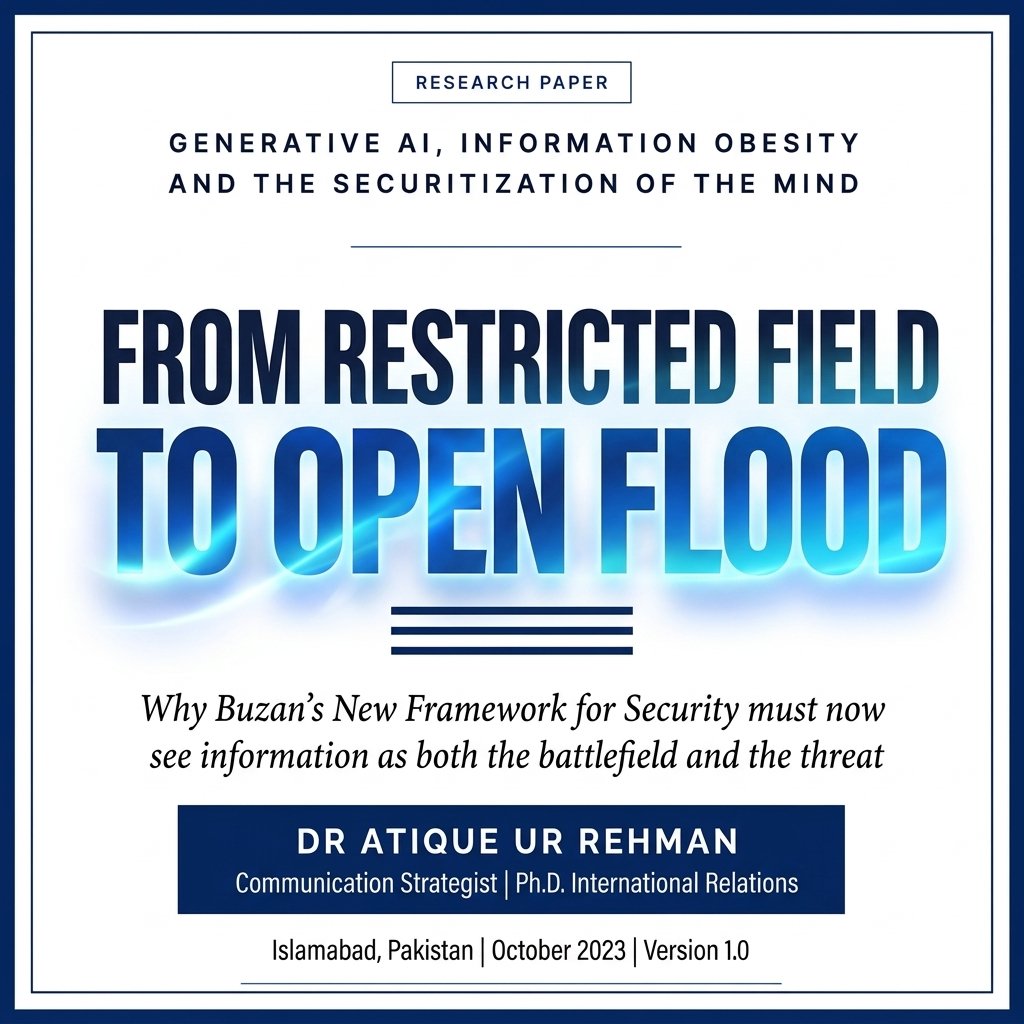
Modern societies rest on an assumption that is rarely stated because it seems obvious: more information produces more knowledge, and more knowledge produces progress. This article argues that the chain is conditional. Every link holds only if what enters it is credible. In an environment saturated with information, which this article calls information obesity, credibility becomes the scarce input. Any deficit in it, whether inaccurate content or bias built into the technologies that produce and route information, passes into knowledge and then into decisions. The result is not just wasted effort. It is a hurdle to progress, because progress depends on knowledge accurate enough to act on.
The argument has four steps. It traces how information became the organising resource of society, shows why information is not knowledge, examines how volume and technological bias each erode credibility, and explains why together they impede progress.
From record to dependence
Floridi (2014) divides human development into prehistory, history and hyperhistory. He treats these as adverbs, ways of living, not periods on a calendar. History begins when societies can record and transmit information. Hyperhistory begins when their welfare depends on processing it. Ur, with its bureaucratic archive of clay tablets, was historical but not hyperhistorical: it still depended on agriculture more than on information. Recording and transmission matured long before processing did. Floridi places the shift in the centuries between Gutenberg and Turing.
Floridi’s life cycle of information matters for this article. Information is created, recorded, transmitted, processed and used. Each stage is a point where credibility can be gained or lost.
Other sources describe the same dependence in economic terms. Bell’s post-industrial thesis, as reported by Sartayeva et al. (2020), sees the information sector overtaking the production of goods, with theoretical knowledge as the organising principle. Haller (2011) argues that technological and informational progress and the knowledge society are interdependent. The authors of the introduction to Between Human and Post-Human Revolutions call the current era a Cybernetic Revolution, the third production revolution after the Agrarian and Industrial. They expect it to end in self-regulating systems.
Webster and Robins (1989) dispute that this is a technological revolution at all. For them, control over information is older than computing and descends from Scientific Management. Even so, the sources agree on the point that matters here: the welfare and power of modern societies now depend on how information is handled.
Information is not knowledge
If dependence on information is the premise, the interesting question is what converts information into knowledge. Capurro and Hjørland (2003) distinguish information as an object, such as bits or documents, from information as a sign that depends on an agent’s interpretation. Their argument is that what counts as informative depends on who is interpreting, for what purpose, and in what social context. Bigirimana (2011) goes further. Knowing, for him, is accumulating insights through information processing. The process enriches raw data with meaning and value for decisions, and it depends on attention, intelligence, reasonableness and responsibility.
Sartayeva et al. (2020) argue that information and knowledge cannot be cleanly separated. They quote Bechmann’s observation that information is deeply ambivalent: it can reproduce ignorance as readily as knowledge.
Two consequences follow. First, information alone guarantees nothing. It supplies raw material, and knowledge is what interpretation makes of it. Second, credibility must hold at two points, the input and the interpreter. Inaccurate information corrupts the first. Bias in the technology that selects and presents information corrupts the second, because it shapes what the interpreter sees. Floridi, as read by Richmond (2016), assigns humans the role of semantic agents who make sense of data. That role is only as good as the material it is given.
Information obesity
Information obesity is volume beyond the capacity to verify, interpret and absorb. The corpus does not use the term, but it describes the condition. Sartayeva et al. (2020), drawing on Kasumova, describe an overproduction of information that leaves people unable even to perceive it, let alone interpret it. Meaning is lost, and they call the result “semantic emptiness”. They add that information increasingly travels through emotional and imaginative channels, with emphasis shifting from content to carrier and image.
Floridi’s concept of information friction supplies the other half of the picture. In Richmond’s summary, friction is the set of bottlenecks in accessing information, and it incidentally protects privacy. It also acted as a filter: what was hard to distribute was, to some degree, selected. As friction falls, volume rises while the capacity to check it does not.
Bigirimana’s list of what knowing requires (attention, intelligence, reasonableness, responsibility) shows why. These are finite human resources. Obesity therefore does not merely add noise. It starves the process that converts information into knowledge, because that process runs on scarce inputs while information becomes abundant.
The bias of technology
Technology is not a neutral pipe. The corpus identifies at least five ways bias enters.
Representation. Isazadeh (2003) observes that all we ever study are imperfect representations of entities, and that the information age has been an age of working with ever lower-level ones. Blok (2023) shows a further step in the European digital twin of the Earth. Its claim to be an accurate one-to-one replica presupposes that the physical Earth is itself data-driven. What can be datafied becomes what counts as real, so the representation begins to shape what is known.
Standardisation and ownership. Tamminen and Deibel (2019) show that in the life sciences, life is increasingly known through codes built on standard language, codes that can be shared, owned and optimised. The standard decides what is knowable and who may know it.
Control. For Webster and Robins (1989), the defining issue is unequal access to and control over information. Their genealogy runs through planning, surveillance and persuasion. On this view, bias in information technology reflects the interests it was built to serve.
Embedded norms. Chang (2012) argues that technology is never a neutral tool. Liberation from one set of embodiments often stabilises or polices others, and technological mediation carries a “technonormative matrix” of assumptions about the default user.
Opacity. Richmond (2016) reads Floridi as describing a world in which technologies increasingly interface only with each other. Specialists become what Richmond calls the new priests, and users upstairs cannot see what happens downstairs. A user cannot audit what they cannot see.
Every one of these operates before anyone reads anything. Critical reading by individuals cannot fix bias that shapes what appears, in what form, and with what standing.
Compounding
Put credibility deficits together with obesity, and three effects follow. This section is the article’s own argument. The sources do not test it.
First, detection fails. Verification capacity is fixed while volume is not, so the share of information that gets checked shrinks. Second, bias becomes systematic. When most information passes through the same technological channels, shared bias is repeated, not averaged out. A large volume of similar material from the same pipeline looks like corroboration, but it is one distortion multiplied. Third, errors recycle. Where technologies increasingly take other technologies’ outputs as inputs, distortions can circulate without a human ever intervening.
The result is knowledge that is abundant, coherent-looking and wrong in consistent ways. That is worse than ignorance, because people act on it. Bechmann’s observation about information’s ambivalence becomes a warning: at scale, it reproduces ignorance with the confidence of knowledge.
The hurdle to progress
If progress depends on knowledge, as Haller (2011) argues, then flawed knowledge is a brake on it. Decisions, policies and innovations built on inaccurate or biased knowledge misallocate effort, and correcting them costs time and resources. Progress is not halted. It is misdirected and slowed by rework.
The cost rises with dependence. Floridi’s hyperhistorical societies rely on information handling for their welfare in a way prehistorical and historical ones did not. The more a society depends on information, the more a credibility failure costs it.
The introduction to Between Human and Post-Human Revolutions identifies a recurrent sequence: euphoria over new tools, delayed recognition of problems, and only then restrictions on use. Its authors argue for anticipating consequences instead. Bekenova et al. (2022) reach a parallel conclusion from a different tradition. They see technological capability outrunning values and argue that responsibility must expand with technical power. As the introduction’s authors observe, autonomous systems remove humans from the loop, which means fewer opportunities to catch errors before they act.
An objection
The obvious objection is that more information is self-correcting. Errors are exposed, competing sources check each other, and open exchange improves accuracy over time. That holds when three conditions are met: verification capacity keeps pace, channels are independent, and access to information is broadly shared. Obesity strains the first, technological concentration threatens the second, and Webster and Robins’ analysis of unequal control challenges the third. Self-correction is not a property of information as such. It is a property of institutions and infrastructure, and those can be degraded.
What follows
If credibility is the binding constraint, it deserves the treatment infrastructure gets. Three implications follow from the sources.
- Provenance and transparency. Knowing where information comes from and how the technology handling it is designed addresses the opacity Richmond describes.
- Interpretive capacity. Bigirimana’s requirements for knowing (attention, intelligence, reasonableness, responsibility) are educational and institutional goals.
- Bekenova et al. and the authors of the Cybernetic Revolution study agree that responsibility has to accompany capability.
Conclusion
Information is necessary for knowledge and knowledge for progress, but neither link is automatic. Credibility is the condition that connects them. Information obesity makes that condition harder to secure, and technological bias means that deficits are often built in before any individual encounters them. A society that treats information volume as progress without securing credibility risks acting confidently on knowledge it has no means to check.
References
Bekenova, Z., Amirkulova, Zh., & Muursepp, P. (2022). Diversity of information reality and human existence in the modern technogenic world.
Bigirimana, S. (2011). Patterns of human knowing in the information society. PhD thesis, Ruprecht-Karls-Universität Heidelberg.
Blok, V. (2023). Philosophy of technology in the digital age. Inaugural lecture, Wageningen University & Research.
Capurro, R., & Hjørland, B. (2003). The concept of information. Annual Review of Information Science and Technology, 37, 343–411.
Chang, E. Y. (2012). Technoqueer: Re/con/figuring posthuman narratives. PhD dissertation, University of Washington.
Floridi, L. (2014). The fourth revolution: How the infosphere is reshaping human reality. Oxford University Press.
Haller, A. P. (2011). Informational and technological progress. International Journal of Economic Practices and Theories, 1(1).
Isazadeh, A. (2003). Beyond the information age: A philosophical perspective. Applied and Computational Mathematics, 2(1), 77–85.
Richmond, S. (2016). Review of Floridi, The 4th Revolution. Kyiv-Mohyla Humanities Journal, 3, 231–235.
Sartayeva, R., Seytakhmetova, N., Kurmangaliyeva, G., Nurysheva, G., & Zhandosova, S. (2020). The phenomenon of information in the modern world: A philosophical approach. Acta Baltica Historiae et Philosophiae Scientiarum, 8(1).
Tamminen, S., & Deibel, E. (2019). Recoding life: Information and the biopolitical. Routledge.
Webster, F., & Robins, K. (1989). Plan and control: Towards a cultural history of the information society. Theory and Society, 18(3), 323–351.
Introduction: Between human and post-human revolutions, or what future is awaiting us? (authors and publication details not identified in source file).
About the Author