


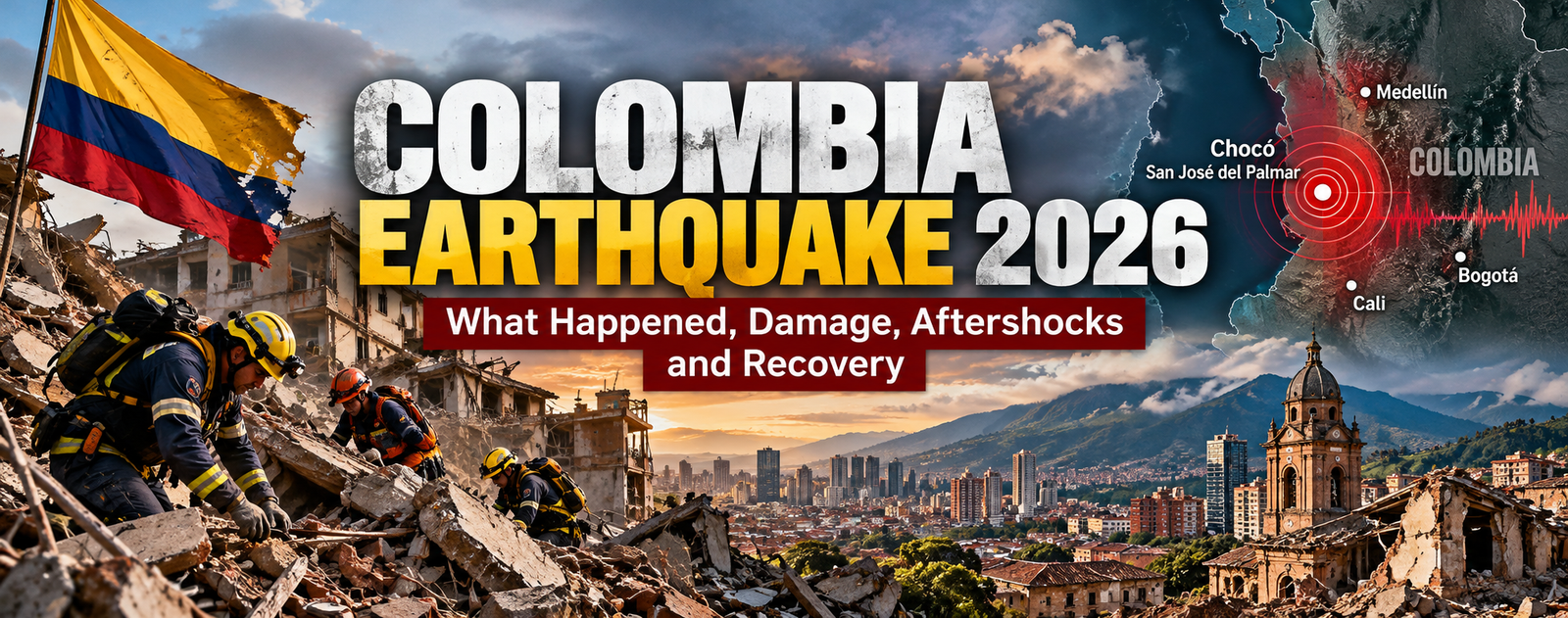
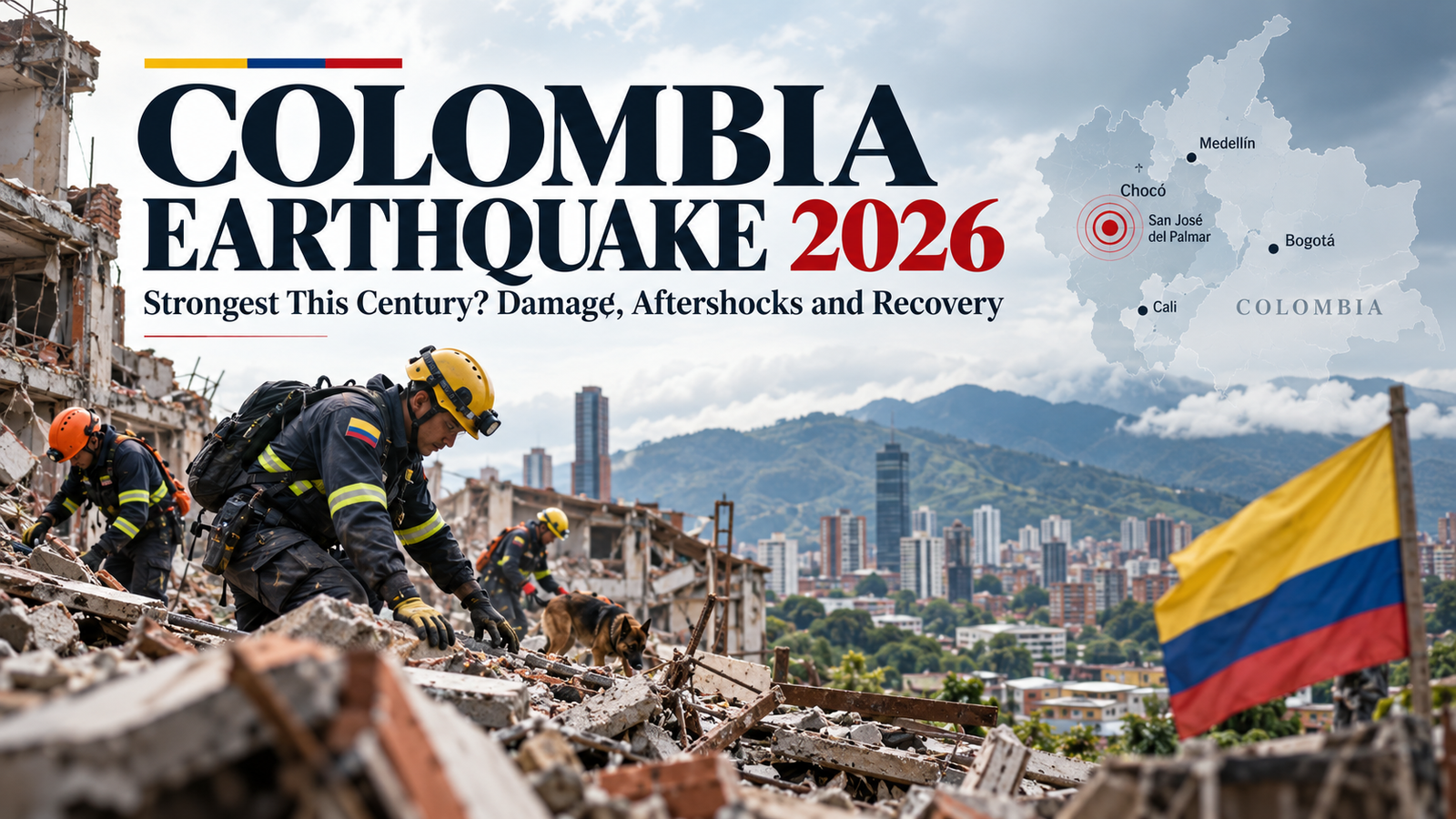
Quick answer: A magnitude 7.4 earthquake struck western Colombia at 7:34 a.m. local time on August 10, 2026, with its epicenter near San José del Palmar in Chocó and a depth of about 103 km. The Colombian Geological Service says it was the largest-magnitude earthquake recorded in Colombia this century. The latest national balance located for this report lists 331 deaths, roughly 4,500 injuries and more than 466,000 people affected. The main shock is over, but seismic activity has continued: by October 5, the SGC had located 339 aftershocks, while a separate seismic swarm was also active in Chocó. www2.sgc.gov.co
Colombia Earthquake 2026: What Happened, Damage, Aftershocks and Recovery
See More News
The disaster affected western and central Colombia most severely, damaging homes, hospitals, schools, roads, bridges and businesses. Two months later, the country has moved from rescue toward a costly reconstruction effort that could require COP 30–40 trillion, according to economic research group ANIF. ANIF
Colombia Earthquake 2026: Key Facts
| Fact | Verified information |
|---|---|
| Date | August 10, 2026 |
| Time | 7:34 a.m. local time |
| Magnitude | 7.4 Mw |
| Epicenter | San José del Palmar, Chocó |
| Depth | About 103 km |
| Historical ranking | Largest in Colombia this century; third-largest instrumentally recorded in national history |
| Deaths | 331 in the latest consolidated national balance located |
| Injured | Roughly 4,500 |
| People affected | More than 466,000 |
| Aftershocks | 339 located by October 5 |
| Tsunami threat from this event | None declared for Colombia’s Pacific coast |
The SGC specifically advises journalists not to describe magnitudes automatically as being “on the Richter scale”; magnitude 7.4 Mw is the technically safer wording. www2.sgc.gov.co
Was This Really Colombia’s Biggest Earthquake This Century?
Yes, but not the biggest in Colombia’s history
The SGC’s first detailed update said the San José del Palmar earthquake was the highest-magnitude earthquake registered in Colombia during the 21st century. A month later, after reviewing the event in greater detail, the agency called it the third-largest magnitude recorded instrumentally in Colombian history. www2.sgc.gov.co
Colombia has experienced much larger historical earthquakes. The strongest instrumentally recorded event affecting the country was the January 31, 1906 Pacific earthquake, estimated at magnitude 8.8, which generated a destructive tsunami. Another magnitude 8.1 earthquake struck the Pacific region in December 1979. www2.sgc.gov.co
So the accurate headline is:
“Colombia’s strongest earthquake of the 21st century,” not “Colombia’s strongest earthquake ever.”
Where Was the Earthquake Damage Worst?
Chocó and San José del Palmar
The epicenter was in San José del Palmar, an area where access and infrastructure were already challenging before the disaster. Roads, homes, public infrastructure and water systems suffered damage across Chocó, while remote communities complicated damage assessments and relief delivery.
The earthquake was generated by Colombia’s complex tectonic setting, including processes associated with the Nazca Plate descending beneath South America. Its considerable magnitude and geological conditions allowed shaking to be felt far beyond the epicentral region. www2.sgc.gov.co
Cali and Valle del Cauca
Valle del Cauca was among the hardest-hit regions. Cali suffered building failures, casualties and disruption to essential services on account of Colombia earthquake 2026.
According to PAHO/WHO’s September assessment, Valle del Cauca and Risaralda together accounted for 93.4% of confirmed earthquake deaths. Valle also recorded the largest number of injured people. Pan American Health Organization
Businesses were hit as well. FEWS NET reported that at least 1,462 businesses in Valle del Cauca had reported damage, with preliminary losses above COP 47 billion by late August. FEWS NET
Pereira, Risaralda and the Coffee Region
Pereira suffered some of the earthquake’s worst urban destruction, with collapsed or badly damaged homes, businesses, schools and health facilities. Reuters reported that the earthquake tore through Colombia’s coffee-growing heartland, with Pereira and Cali accounting for a large share of the early death toll. Investing.com
The shock also hurt commerce. FEWS NET reported that around 70% of businesses surveyed in Pereira had been affected, with 34% still closed in late August. FEWS NET
Bogota Earthquake Effects
The Bogota earthquake search term is popular, but Bogotá was not the epicenter and was not among the worst-hit areas.
The capital experienced strong shaking and thousands of emergency calls. Authorities received reports of cracks and non-structural damage, but IDIGER said inspections had not identified major structural damage in the city. Bogotá’s metro construction was also inspected and cleared to continue. Bogotá.gov
Earthquake Medellin and Antioquia
The Colombia earthquake 2026 was also strongly felt in Medellín and Antioquia. Antioquia’s government reported impacts across dozens of municipalities, with Támesis among the most affected locations. antioquia.gov.co
That makes earthquake Medellin relevant as a supporting search term, but the main story remains concentrated farther west and south.
Are Aftershocks Still Happening in Colombia?
Yes, although the main aftershock sequence of Colombia earthquake 2026 has been declining.
The SGC reported 339 located aftershocks by October 5, concentrated mainly around San José del Palmar, Litoral del San Juan and Sipí at depths of roughly 70–105 km. The agency said both their frequency and magnitude were progressively decreasing and that no aftershock stronger than magnitude 4 had been located since August 13. www2.sgc.gov.co
However, scientists have also identified a separate seismic swarm around Istmina, Medio San Juan, Sipí and Litoral del San Juan. A swarm differs from an aftershock sequence because there may be no single dominant main shock. www2.sgc.gov.co
This does not mean another major earthquake is about to happen. Earthquakes cannot currently be predicted with enough precision to say where and when the next damaging event will occur.
How the Earthquake Affected Colombia’s Economy
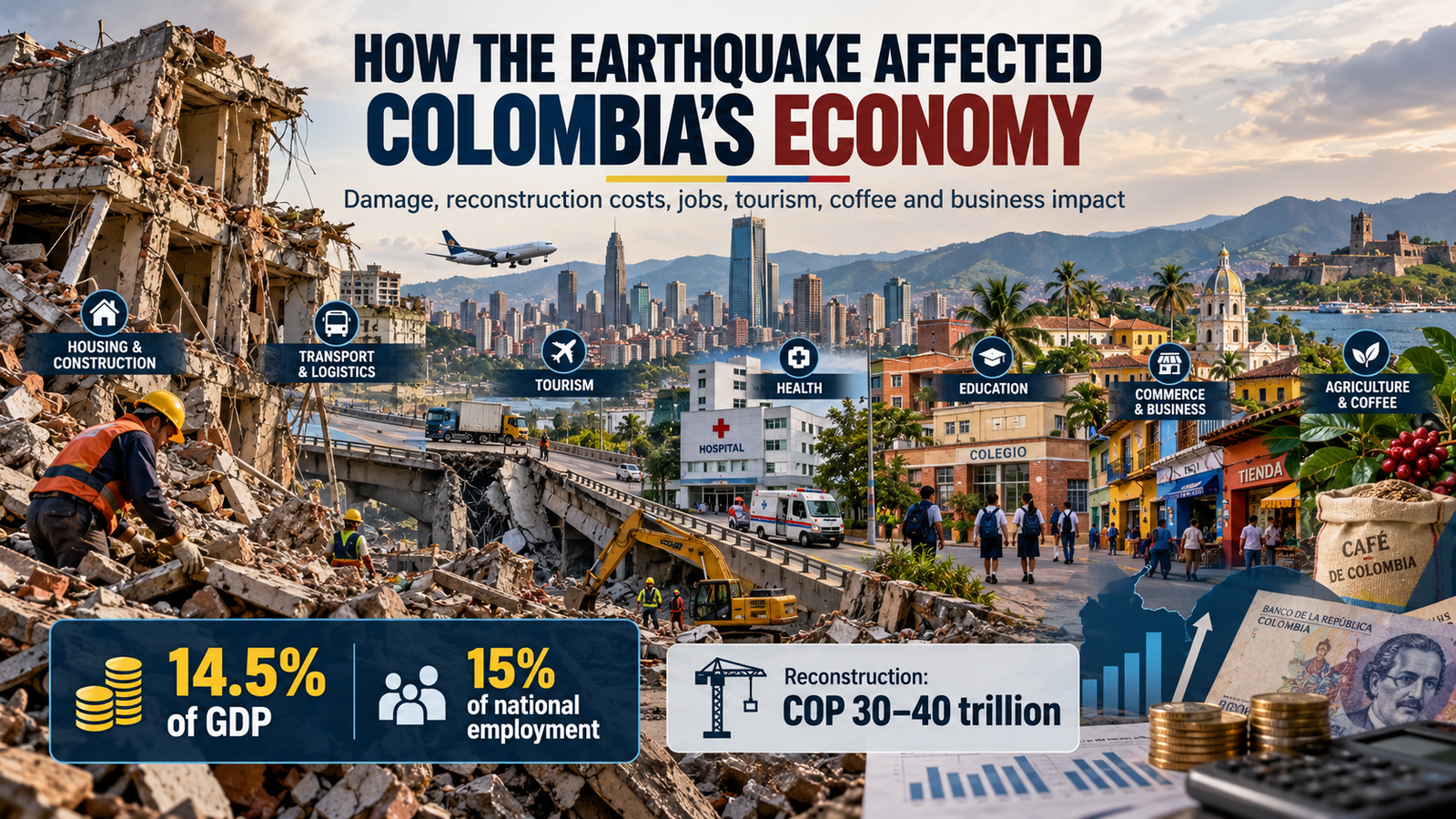
The economic effect of Colombia earthquake 2026 goes well beyond damaged buildings.
ANIF notes that Valle del Cauca, Chocó, Risaralda, Caldas and Quindío together account for roughly 14.5% of Colombia’s GDP and 15% of national employment. These regions are important for commerce, agriculture, tourism, transportation and food distribution. ANIF
| Sector | Main impact |
|---|---|
| Housing & construction | Tens of thousands of homes destroyed; hundreds of thousands damaged |
| Transport | Roads, bridges and five airports reported affected |
| Health | Hundreds of health facilities damaged; continuity measures introduced |
| Education | Thousands of campuses affected, although classes have since been restored |
| Tourism | Visitor cancellations hurt towns in the Coffee Cultural Landscape |
| Commerce | Business closures and property losses in Pereira, Cali and surrounding cities |
| Agriculture | Farms and processing facilities damaged, especially in rural areas |
| Public finances | Reconstruction could cost COP 30–40 trillion |
ANIF’s October assessment warned that such reconstruction costs are arriving when Colombia already faces limited fiscal room. ANIF
Coffee was affected, but the earthquake is not the main harvest threat
About 10,500 coffee-growing families were affected, according to the National Coffee Growers Federation. However, federation head Germán Bahamón told Reuters that the quake had not materially damaged national coffee production; El Niño and weather conditions pose the greater risk to the 2026 crop. Export operations through Buenaventura also resumed. Reuters
Tourism suffered a confidence shock
Tourist centers such as Salento escaped the worst physical destruction but suffered cancellations as visitors stayed away from the Coffee Region following the Colombia earthquake 2026. That creates a secondary economic effect even where buildings survived. EFE Noticias
What Experts Say the Earthquake Means
SGC: the earthquake is scientifically unusual and still being studied
The SGC has deployed teams to more than 20 municipalities and continues examining the aftershock sequence and seismic swarm. Scientists emphasize that Colombia is naturally earthquake-prone because several tectonic systems interact beneath the country. www2.sgc.gov.co
Engineers: local soil conditions amplified shaking
The Colombian Society of Engineers says measurements from Pereira and Manizales showed an important lesson: shaking reaching underlying rock was moderate in places, but local soil deposits amplified motion at the surface. The findings could influence future structural design, retrofitting and seismic codes. sci.org.co
Economists: reconstruction is now a national fiscal issue
ANIF’s research team argues that the disaster is no longer only a regional reconstruction challenge. With affected departments accounting for a substantial share of national GDP and estimated reconstruction costs approaching COP 30–40 trillion, it could influence government finances, investment and growth decisions. ANIF
Relief Missions and International Response
Colombia received one of the largest international relief mobilizations in the region this year.
By August 16, Colombia’s Foreign Ministry reported more than 220 tonnes of bilateral humanitarian assistance and 144 international specialists already working in the country. El Salvador, Mexico, Chile and Peru sent supplies; Israel, Ecuador and the United States deployed specialist teams. default.consulado.gov.co
Additional assistance included:
- United States: humanitarian funding and search-and-rescue personnel.
- European Union: more than €2 million in emergency support, satellite mapping and civil-protection assistance. EmergencyAidEurope
- China: 77.6 tonnes of tents, blankets, water-related equipment and other supplies. Unidad Nacional del Riesgo
- Spain: more than 95,000 units of medicines worth around €350,000. MinSalud
- Italy: €1.5 million in immediate multilateral humanitarian assistance plus planned recovery programs. Ministero degli Affari Esteri
- United Nations agencies: shelter, food, health, protection, sanitation and recovery assessment. un-dco.org
- IFRC/Colombian Red Cross: a CHF 25 million emergency appeal designed to support vulnerable communities over 24 months. ifrc.org
A month after the earthquake, UNGRD said 1,849 rescuers from Colombia and international teams had participated in more than 288 hours of search-and-rescue activity. Unidad Nacional del Riesgo
What Happens Next?
Colombia has moved decisively from emergency rescue to reconstruction.
On October 7, the government formally activated the Fondo Milagro, initially capitalized with COP 1 trillion, to manage public and private reconstruction resources. The UNGRD has also completed a preliminary post-disaster recovery plan after analysing roughly 950,000 data points and 94 situation reports. presidencia.gov.co
One encouraging milestone is education. By September 29, the Education Ministry said classes had been restored for 100% of the 1.27 million students whose schooling had been affected, although reconstruction of damaged campuses continues. Portal MEN – Presentación
The longer-term challenge will be rebuilding homes, hospitals and roads in ways that reduce future seismic risk rather than merely recreating the same vulnerabilities.
What Should People Do During an Earthquake or Aftershock?
Colombian disaster authorities recommend preparation rather than trying to predict other Colombia earthquake 2026.
- During shaking: stay calm; Drop, Cover and Hold On under sturdy furniture where possible; keep away from windows, façades and falling objects; do not use elevators.
- Outside: move away from buildings, poles, trees and electrical lines.
- After shaking stops: check for injuries, structural damage, gas leaks and damaged electrical or water lines. Do not re-enter seriously damaged buildings until authorities clear them.
- Prepare ahead: keep water, medication, food, flashlight, batteries, whistle, radio, identification documents and cash in an emergency kit.
- Follow official information: use the SGC, UNGRD and local emergency authorities rather than viral earthquake predictions on social media. www2.sgc.gov.co
For people on Colombia’s Pacific coast, there is one extra rule: if the Colombia earthquake 2026 is so strong that standing becomes difficult, move inland and uphill because a coastal earthquake can generate a tsunami. The August 10 earthquake itself did not create a tsunami threat, according to Colombia’s maritime authority DIMAR. dimar.mil.co
Frequently Asked Questions About the Colombia Earthquake
When was the last major earthquake in Colombia?
The most recent major destructive earthquake was the magnitude 7.4 San José del Palmar earthquake on August 10, 2026. It remains the country’s strongest earthquake of the 21st century. www2.sgc.gov.co
Is Colombia still having earthquakes right now?
Colombia experiences earthquakes regularly. The major August 10 sequence has continued with diminishing aftershocks; the SGC had located 339 of them by October 5. Separate seismic swarm activity has also continued in Chocó. www2.sgc.gov.co
Was there a tsunami alert in Colombia?
No tsunami threat was declared for the August 10 earthquake. DIMAR stated shortly after the event that Colombia’s Pacific coast was not under tsunami threat. dimar.mil.co
Did a magnitude 9.5 earthquake happen in Colombia?
No. Google’s related questions can be misleading here. The magnitude 9.5 earthquake occurred in Chile on May 22, 1960, and remains the world’s largest instrumentally recorded earthquake. USGS
What were the worst earthquakes in Colombia?
The country’s largest instrumentally recorded earthquake was the 1906 Pacific event, estimated at Mw 8.8. The 1979 Pacific earthquake measured Mw 8.1. The 2026 San José del Palmar earthquake, at Mw 7.4, ranks among Colombia’s largest instrumentally recorded events and is the strongest of this century.
About the Author