


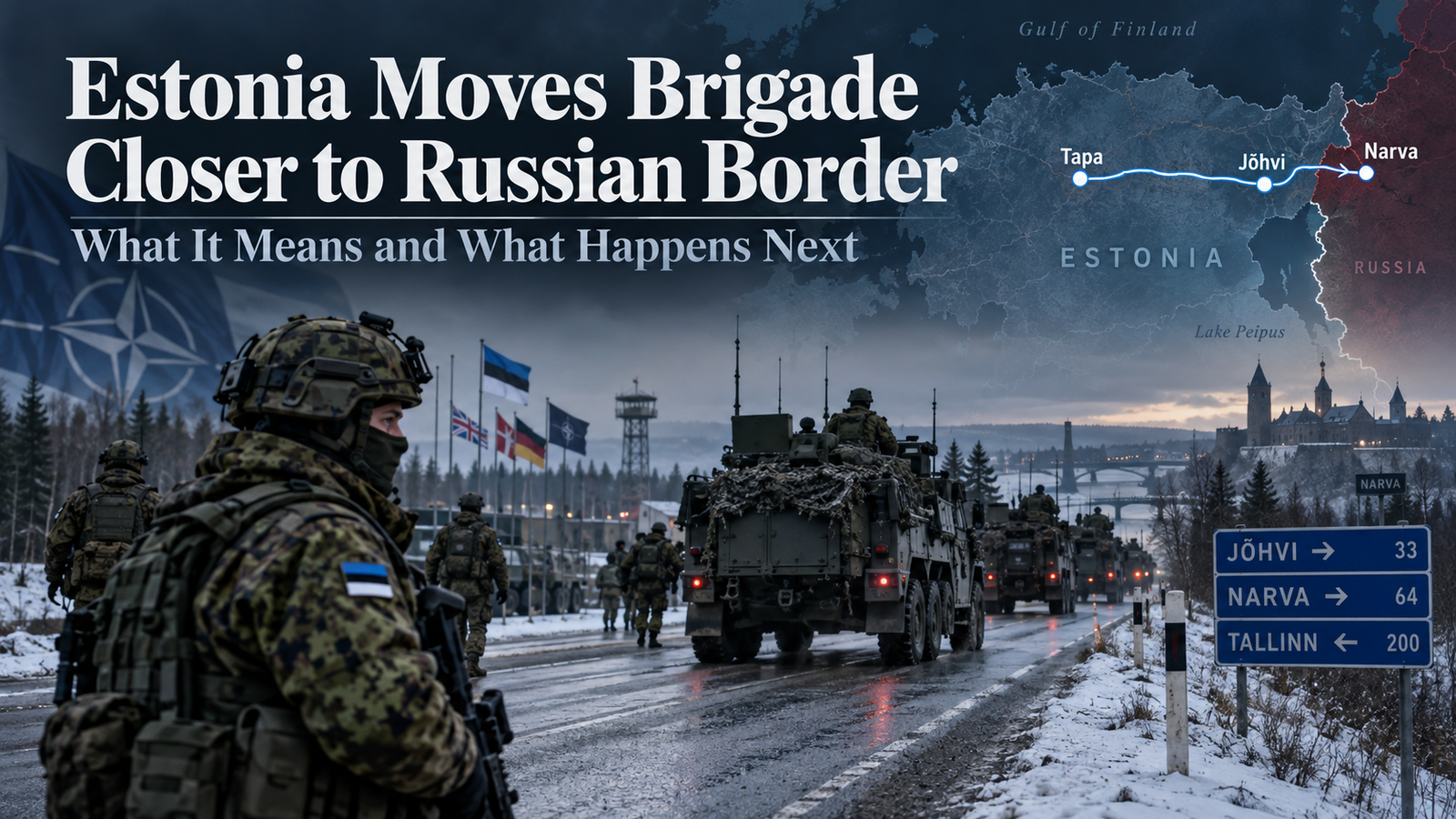
Estonia moves brigade closer to Russian border as the war in Ukraine nears its fifth year and officials in Tallinn plan for what happens when the fighting stops. This post explains the move, what experts say, what could happen next, and what residents and travelers should do.
See More Current Issues
Estonia Moves Brigade Closer to Russian Border: What It Means and What Happens Next
Quick answer: Estonia moves brigade closer to russian border, its main combat formation, from Tapa to Jõhvi, less than 50 kilometers from the Russian border. The Financial Times reported the shift on October 5, 2026, as part of an “active defense” strategy meant to stop an attack at the border, not after it. Estonian officials do not expect a full-scale Russian attack on NATO soon, but they fear a limited operation designed to test the alliance.
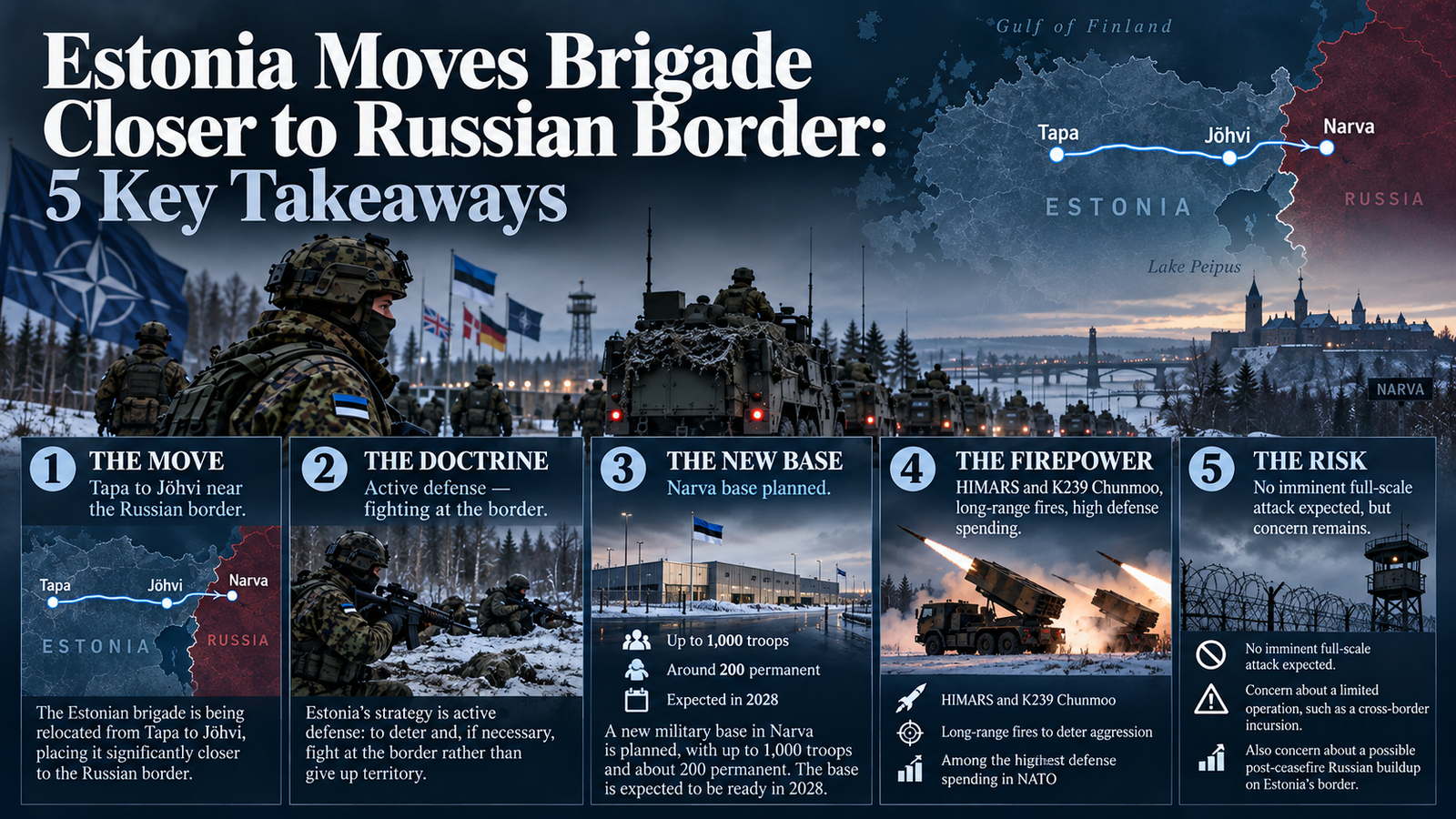
Estonia Moves Brigade Closer to Russian Border: 5 Key Takeaways
- The move. Estonia moves brigade closer to russian border The brigade is relocating from Tapa to Jõhvi, under 50 kilometers from Russia, according to the FT.
- The doctrine. “Active defense” means fighting at the border instead of trading territory while waiting for NATO reinforcements.
- The new base. A base in Narva is planned for up to 1,000 troops, about 200 of them permanent, and is expected in 2028.
- The firepower. Estonia has contracted nine HIMARS and nine K239 Chunmoo launchers, each with a range of up to 300 kilometers, and is spending about 5.4% of GDP on defense.
- The risk. Officials expect no full-scale attack soon but fear a limited operation near Narva, or a Russian buildup after a ceasefire in Ukraine.
What Happened: The Move Explained
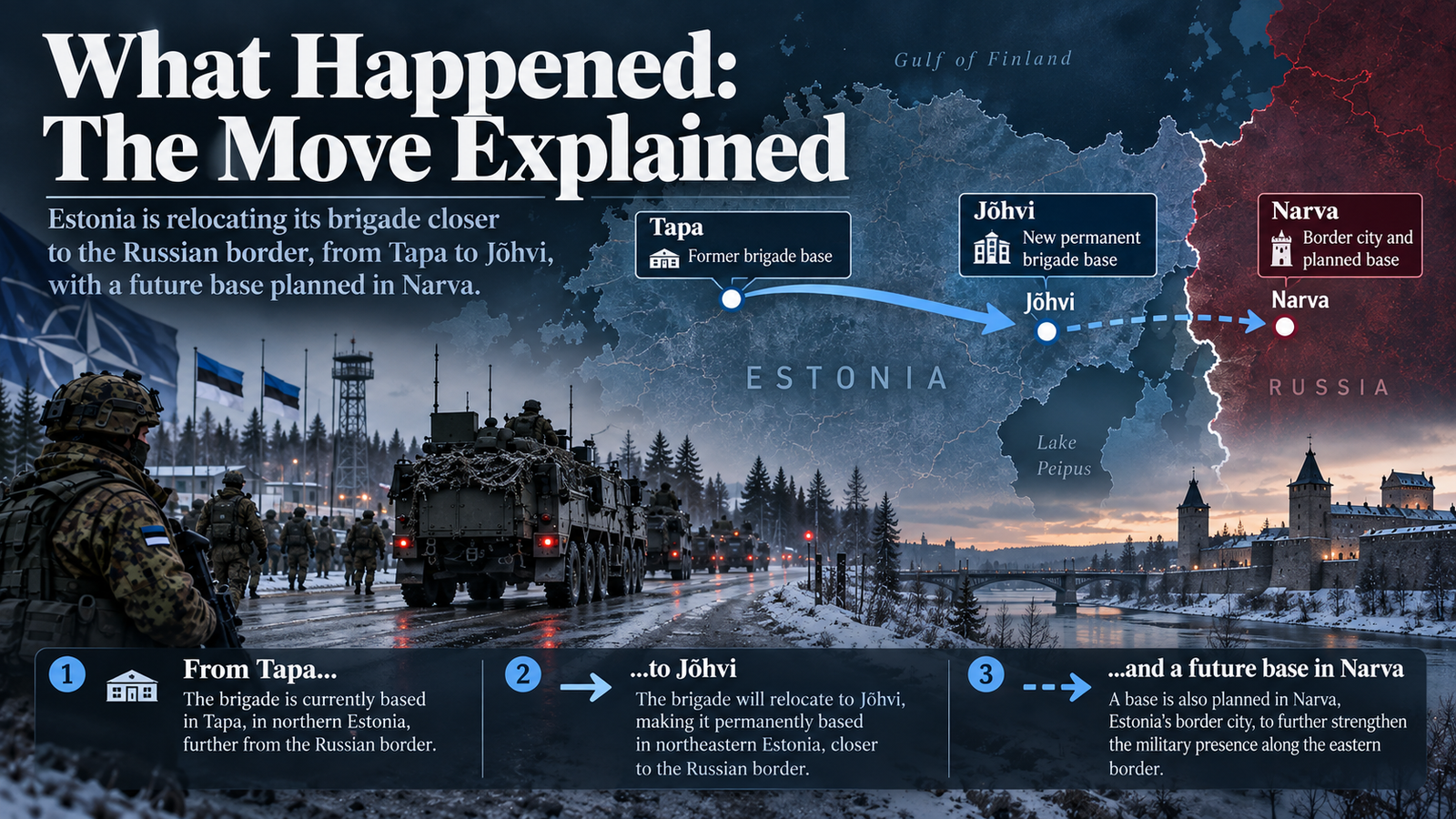
Where the Brigade Is Moving
Estonia moves brigade closer to russian border and Estonia 1st Infantry Brigade is the country’s main combat-ready land unit. Its headquarters is leaving Tapa for the Jõhvi military base, which has received about €20 million in new infrastructure, including barracks and training facilities, according to ERR. Jõhvi lies just west of Narva, the border city, as the Kyiv Independent reported.
| Location | Distance from the Russian border | Role |
|---|---|---|
| Tapa | Well over 100 km | Former brigade base |
| Jõhvi | Under 50 km | New permanent brigade base |
| Narva | On the border | New base for up to 1,000 troops, about 200 permanent, due in 2028 |
Estonia Active Defense Strategy: What It Means
Estonia added “active defense” to its national security concept in May 2026, according to FT-based reports. The earlier plan, as Kyiv Post summarized the FT, was to let an attacker enter Estonia and slow it with guerrilla-style resistance until NATO reinforcements arrived.
The new approach is a form of forward defense. The Tallinn-based International Centre for Defence and Security describes forward defense as a military presence strong enough to deny an attacker success, rather than relying on reinforcement and punishment later. Brigade commander Col. Tarmo Kundla told the FT: “We have to start from the border and win from the first battles.” The Kyiv Independent added that the plan includes the ability to strike targets deeper in Russia.
Why Estonia Is Changing Its Plan
- Russian buildup. Kaupo Rosin, head of Estonia’s Foreign Intelligence Service, told the AP in February that Russia plans to multiply its prewar force along the NATO border by two to three times.
- Narva’s exposure. The city sits on the border and is mostly Russian-speaking. Estonia fears a repeat of the 2014 pretext of protecting Russian speakers.
- A possible ceasefire. Officials worry that battle-hardened troops now tied down in Ukraine could be redeployed once fighting ends.
- Reliance on allies. Estonia depends on NATO airpower and Article 5. The Kyiv Independent noted that U.S. questioning of Article 5 has unnerved eastern flank members.
Expert Opinions: What the Move Means
Estonian Military and Government
Defense Minister Hanno Pevkur has called a stronger presence in Narva essential to protecting territory “from the very first meter”. Maj. Gen. Vahur Karus, chief of the general staff, has warned that a pause in the Ukraine fighting would let Moscow shift its focus and test NATO and Estonian readiness, ERR reported. The defense ministry’s stated aim is to keep the enemy and the destruction of war away from Estonian territory.
Intelligence Assessments
Rosin’s February assessment was that Russia has no intention of attacking Estonia or any NATO member in the coming year, though its military reform will raise its capability. He said there was “no reason to panic”. In August he repeated that Russia is trying to avoid open conflict with NATO but warned the situation could change, the Moscow Times reported.
Other Western officials are less relaxed. The same report cited NATO Secretary General Mark Rutte saying the alliance must prepare for a possible attack within five years, and German Defense Minister Boris Pistorius suggesting a conflict could come within a couple of years.
Independent Analysts
Security policy expert Olena Davlikanova says the string of hybrid incidents across Europe increasingly resembles a sub-threshold war. Strategic foresight expert Leopold Schmertzing calls it a war “fought in small steps” and fears Europeans will not fully wake up until their capitals are hit. These experts speak about Europe broadly, not Estonia specifically. They also say gaps remain in air defense, drones, communications, intelligence and joint command.
Taken together, the sources suggest the move is about deterrence, not preparation for an imminent attack. Forward positioning also puts forces closer to a potential adversary, a trade-off Estonia is answering with long-range fires and fortified positions.
What Could Happen Next
These are possibilities raised by officials and analysts, not predictions.
| Scenario | What it could look like | What to watch |
|---|---|---|
| Deterrence holds | No attack, while Russia keeps rebuilding and probing | Intelligence updates, Russian force changes near the estonia russia border |
| Limited test near Narva | A hybrid or limited action meant to test NATO’s response | Border incidents, disinformation aimed at Narva |
| Post-ceasefire buildup | Russian troops freed from Ukraine move toward NATO’s border | Ukraine ceasefire talks, new Russian units |
| More allied presence | Added rotations, such as a U.S. unit due in Estonia in November | Allied announcements |
The Narva base is not expected before 2028, according to Kyiv Post, so the full effect of the plan will take time.
What People Should Do: Protocols and Strategies
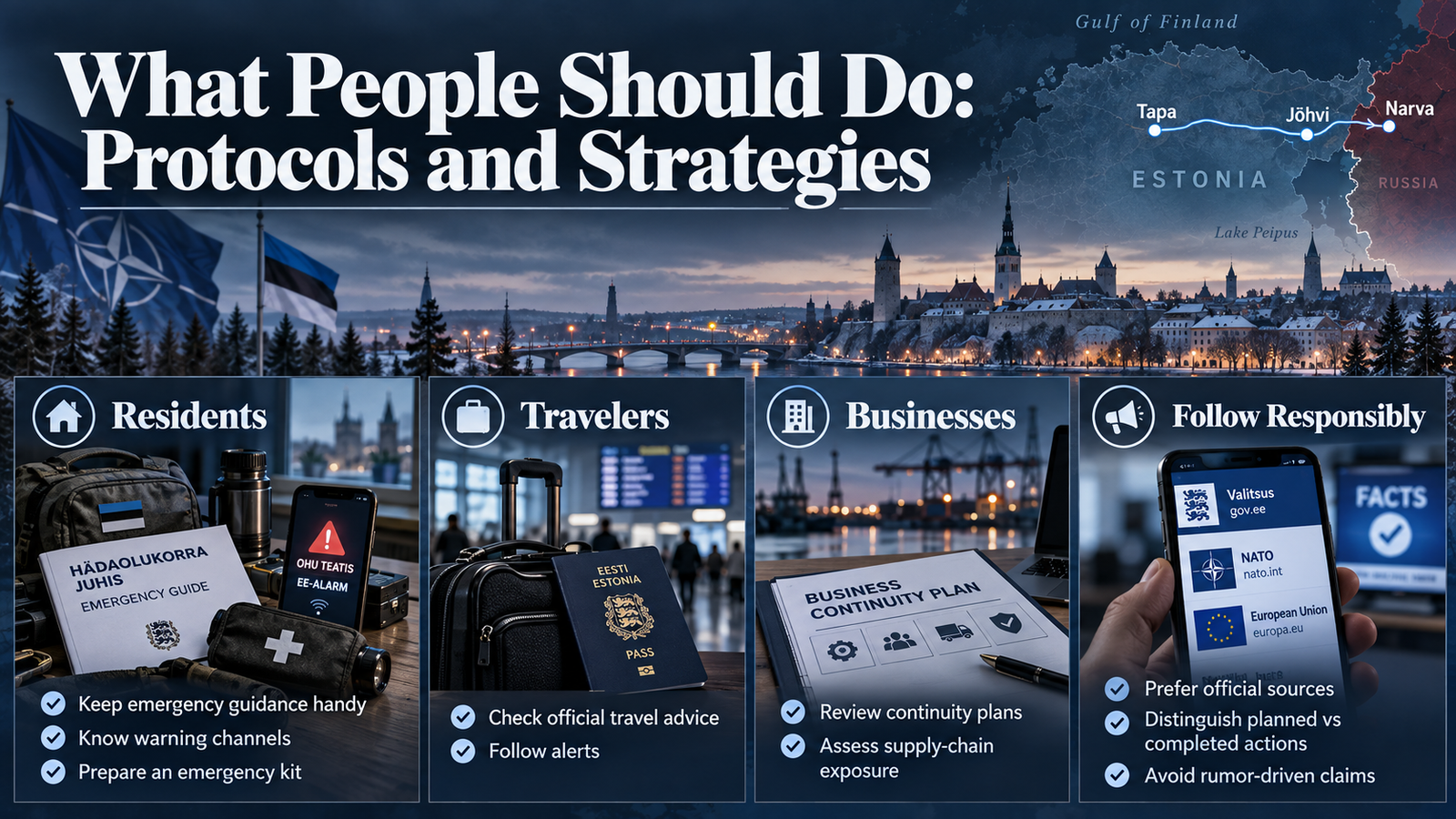
If You Live in Estonia
Follow the Rescue Board’s guidance:
- Keep the printed hazard guide somewhere easy to find. It covers sirens, evacuation, sheltering and emergency supplies, and comes in Estonian, Russian, English and Ukrainian.
- Know the warning channels: EE-ALARM mobile messages, sirens, door-to-door notices and vehicle loudspeakers.
- Call the state information line 1247 or visit kriis.ee for official instructions.
- Build the emergency kit the guide recommends, and check its current quantities.
If You Are Traveling to Estonia
None of the reports reviewed mention travel restrictions tied to the move. Check your own government’s current travel advice before departure, and follow official alerts while there.
If You Run a Business or Follow Markets
Review continuity plans and supply chain exposure in the Baltic region, and rely on official statements over rumors. This is general information, not financial or security advice.
How to Follow the Story Responsibly
- Prefer primary sources: the Estonian Ministry of Defence, the Defence Forces, ERR and NATO.
- Note that much coverage repeats one paywalled FT report.
- Check whether a claim says “planned”, “began” or “completed”.
- Treat single-source viral claims with caution.
Frequently Asked Questions About Estonia’s Brigade Move
Why is Estonia moving its brigade closer to the Russian border?
Estonia wants to stop an attack at the border instead of letting an attacker advance and waiting for NATO reinforcements. Officials cite Russia’s planned buildup, Narva’s exposure, and the risk of troops being freed after a ceasefire in Ukraine.
Where is the 1st Infantry Brigade moving?
Its main units and headquarters are moving from Tapa to Jõhvi, under 50 kilometers from the Russian border. A separate base in Narva is planned for up to 1,000 troops, about 200 permanent.
Is Russia about to attack Estonia?
Estonia’s intelligence service said in February that Russia has no intention of attacking Estonia or any NATO member in the coming year. Officials still fear a limited operation designed to test NATO.
What is Narva and why does it matter?
Narva is an Estonian city on the Russian border with a mostly Russian-speaking population. Estonian officials see it as a possible flashpoint for hybrid or limited action.
What weapons is Estonia buying?
Estonia has contracted nine U.S. HIMARS and nine South Korean K239 Chunmoo rocket launchers, each with a range of up to 300 kilometers, along with drone networks, according to Kyiv Post’s summary of the FT.
How should Estonian residents prepare for a crisis?
Keep the Rescue Board’s printed guide accessible, know the EE-ALARM and siren warnings, and call 1247 or visit kriis.ee for official instructions.
About the Author