


Quick answer:The Fourth Revolution is philosopher Luciano Floridi’s name for the information revolution. It follows the revolutions associated with Copernicus, Darwin and Freud, and it means humans now live as informational organisms inside an infosphere. Understanding that shift is the first step. Acting inside it takes strategy, verification, narrative and governance.
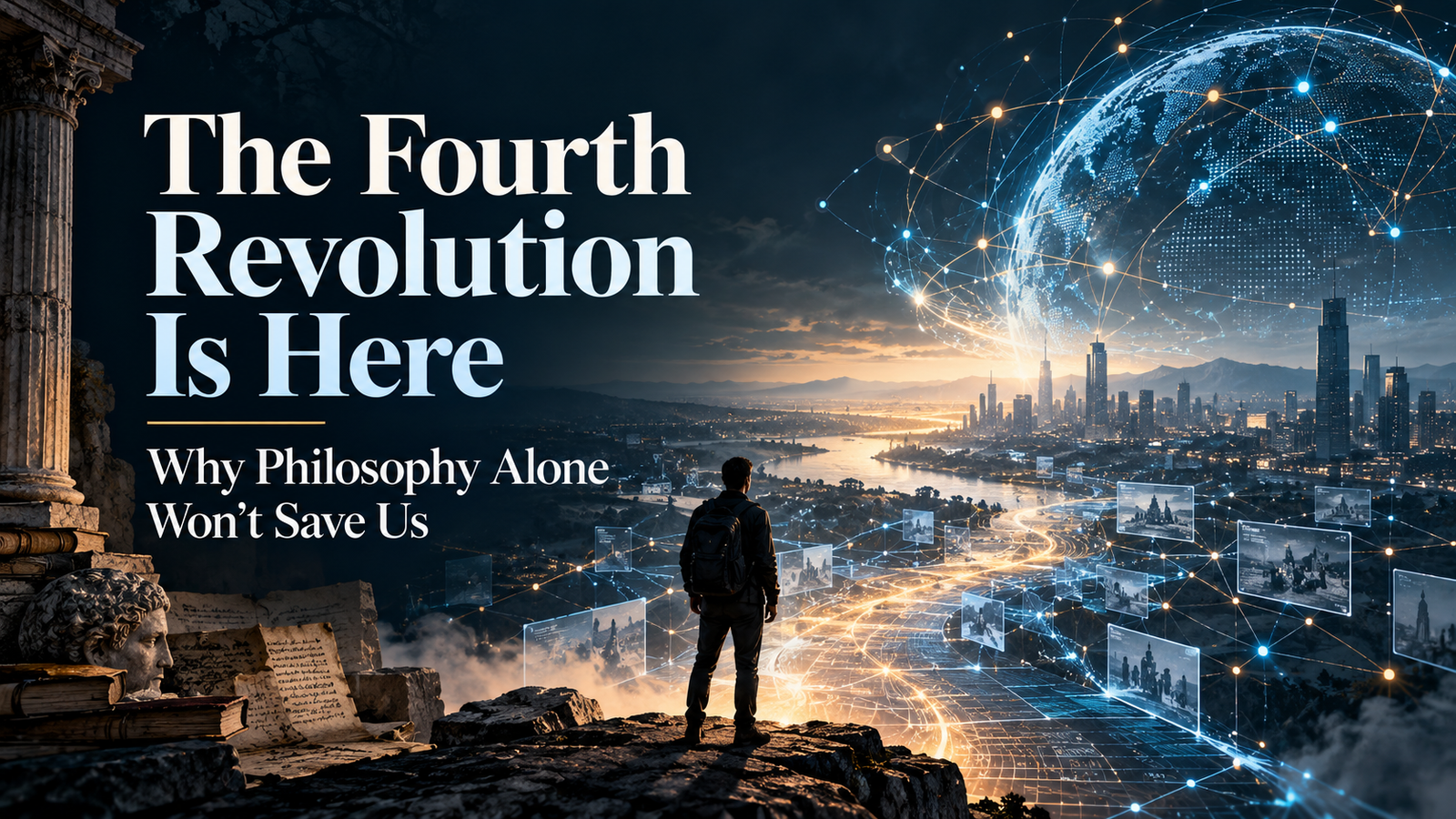
The Fourth Revolution Is Here: Why Philosophy Alone Won’t Save Us
See More Informative Content
We are living through what philosopher Luciano Floridi calls the Fourth Revolution. It is not the industrial revolution of steam and steel, and it is not only the digital revolution of computers and networks. It is the information revolution: the moment when human life itself became dependent on the constant flow, filtering, and manipulation of data.
Philosophers of information, most notably Floridi, have given us the vocabulary for this new condition. We are informational organisms inhabiting an interconnected infosphere. We have entered hyperhistory, an era in which societies, economies, and even personal identity depend on technologies that process information.
What Is the Fourth Revolution?
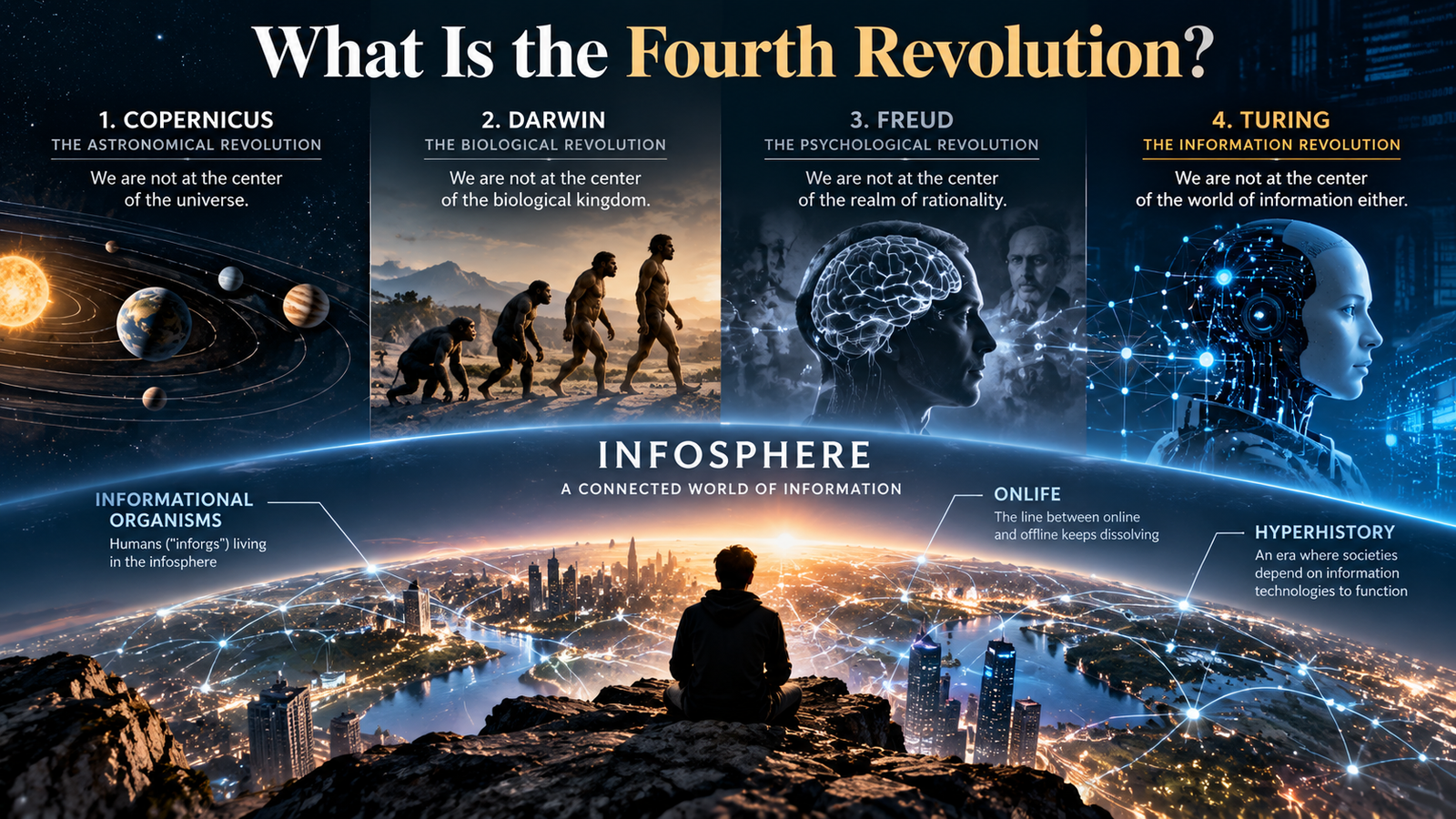
Floridi’s Four Revolutions
| Revolution | Associated thinker | What it changed |
|---|---|---|
| First | Copernicus | Humans are not at the center of the universe |
| Second | Darwin | Humans are not at the center of the biological kingdom |
| Third | Freud | Humans are not at the center of the realm of rationality |
| Fourth | Turing | Humans are not at the center of the world of information; we share the infosphere with smart technologies |
In The Fourth Revolution: How the Infosphere Is Reshaping Human Reality (Oxford University Press, 2014), Floridi argues that three earlier revolutions changed how humanity sees its place in the world. Copernicus showed we are not at the center of the universe, Darwin that we are not at the center of the biological kingdom, and Freud that we are not at the center of the realm of rationality. Floridi attributes the fourth to Alan Turing. After Turing, humans are no longer at the center of the world of information either, because we now share the infosphere with smart technologies. Floridi sets out this argument in his reply to a critical review.
The Infosphere and Informational Organisms
The infosphere is the global environment made of information and the technologies that carry it. Floridi calls the people who live inside it informational organisms, or “inforgs”. Because the line between online and offline life keeps dissolving, he describes our existence as “onlife”.
Hyperhistory
Floridi divides human development into prehistory, history, and hyperhistory. In hyperhistory, societies do not merely record information. They depend on information and communication technologies to process it and to function.
Fourth Revolution vs Fourth Industrial Revolution
The two terms are often confused, but they are different ideas. Floridi’s Fourth Revolution is a claim about how humans understand themselves. The Fourth Industrial Revolution is a term popularised by Klaus Schwab and the World Economic Forum in the mid-2010s for the fusion of technologies such as AI and robotics. They overlap in subject matter but not in meaning.
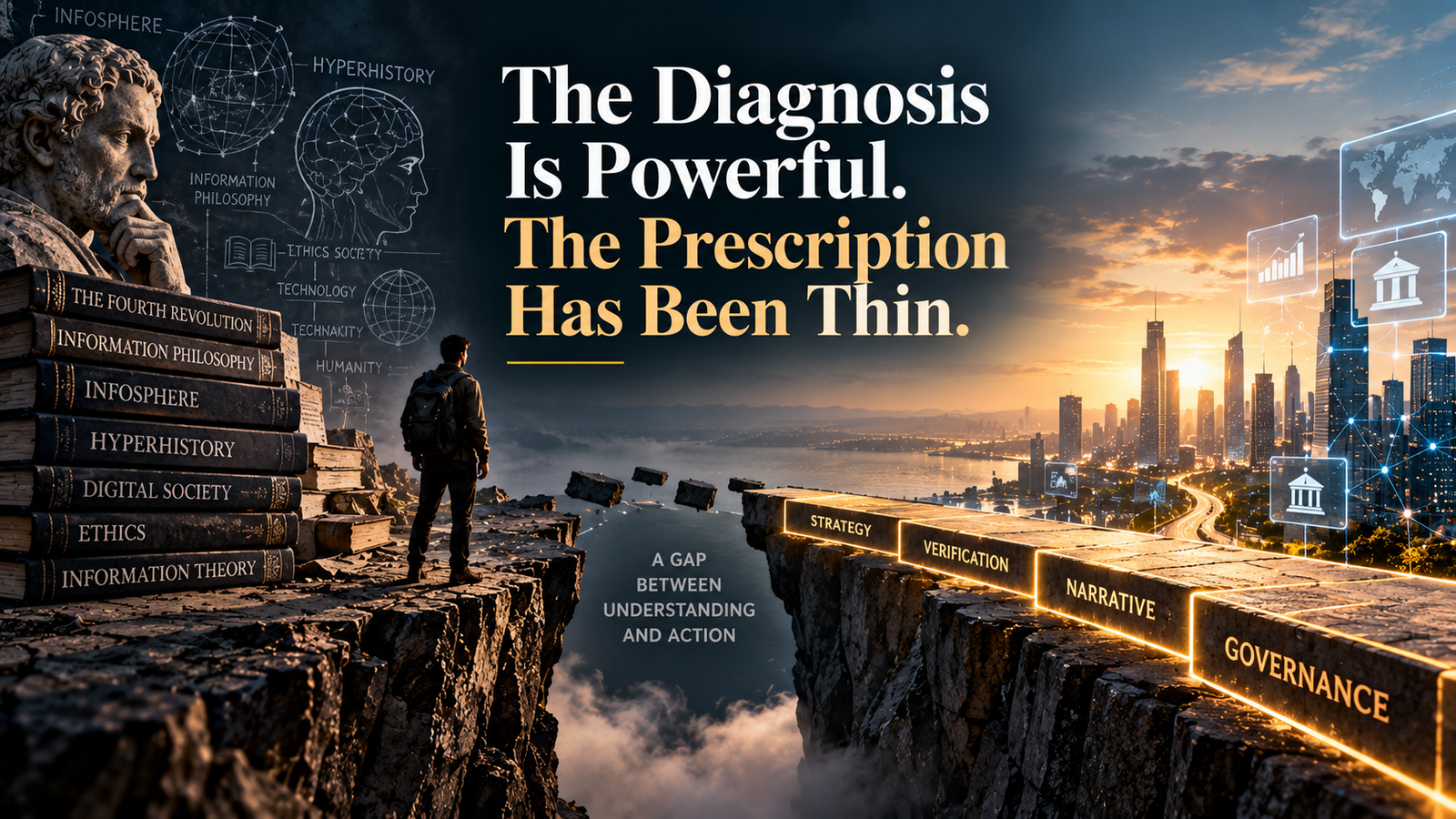
The Diagnosis Is Powerful. The Prescription Has Been Thin.
Why Description Is Not Enough
Most of the literature stops at description. It maps the new terrain with elegant precision and then leaves the rest of us (citizens, leaders, entrepreneurs, institutions) standing on the edge of it, unsure how to move. That is the gap Dr. Atique Ur Rehman’s work is trying to close.
From Insight to Operational Doctrine
His eleven-book catalogue does not reject the philosophical foundation. It starts from it. Then it does something rarer: it translates abstract insight into operational doctrine.
Information Conflict: Attention as Territory
The Infosphere as Battlefield
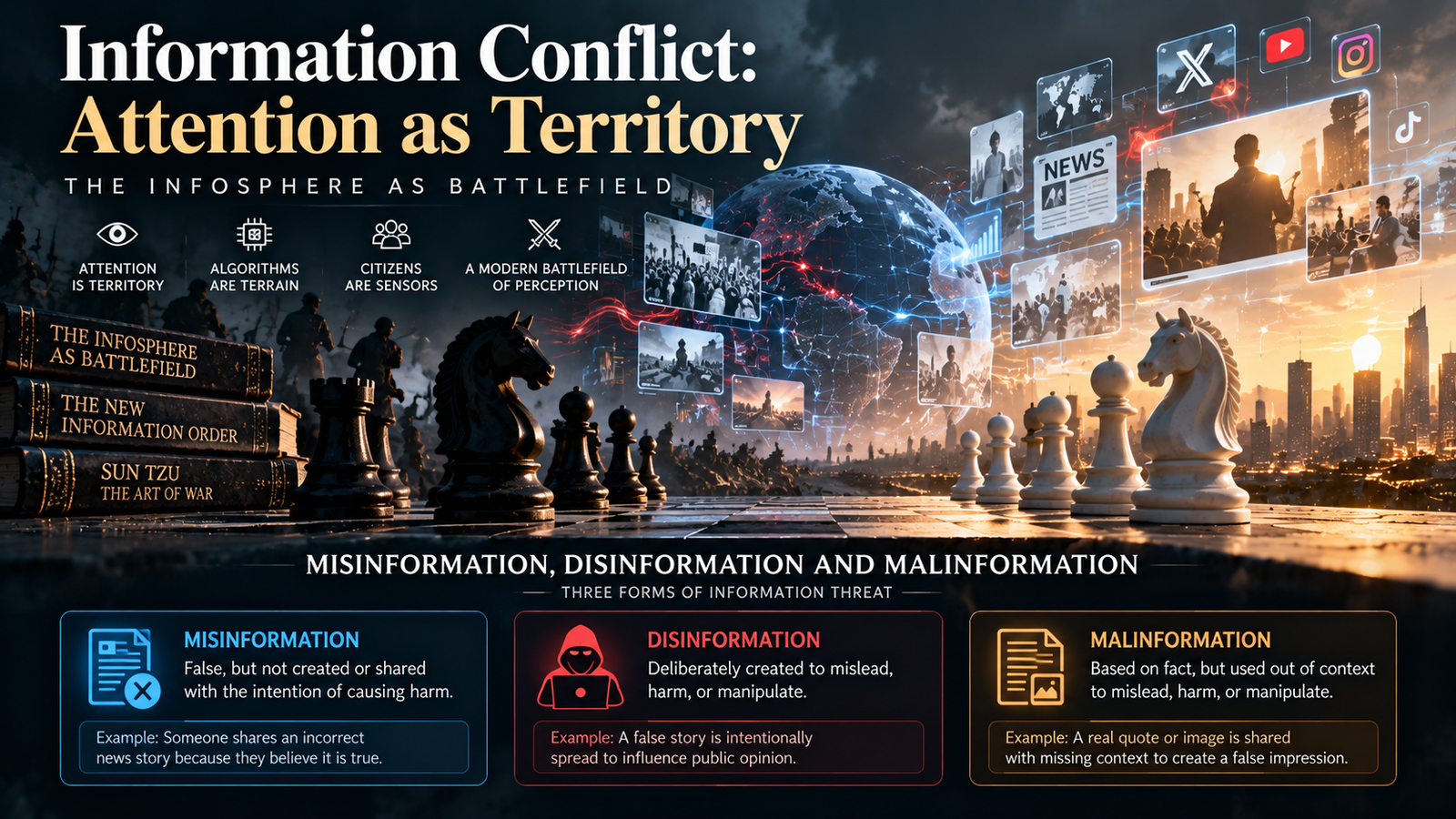
In The Infosphere as Battlefield and The New Information Order, the abstract notion of cyber-conflict becomes concrete strategy. Attention is treated as territory. Algorithms become terrain. Citizens function as sensors. Sun Tzu is rewritten for an age in which the decisive battles are fought over perception rather than physical ground.
Misinformation, Disinformation and Malinformation
Strategy in this space starts with precise terms. The U.S. Cybersecurity and Infrastructure Security Agency defines three categories. Misinformation is false, but not created or shared with the intention of causing harm. Disinformation is deliberately created to mislead, harm, or manipulate. Malinformation is based on fact, but used out of context to mislead, harm, or manipulate.
Verification, Meaning and Governance: One Pattern Across the Catalogue
The same pattern appears across the catalogue. Each book takes a concern from the philosophical literature and turns it into guidance.
From Drowning in Data to Verification
Where commentary on the information age warns that we are drowning in data while starving for meaning, The Architecture of Information offers frameworks for verification and sense-making.
From Symbols to Meaning
Many theorists note the difference between machines that manipulate symbols and humans who create meaning. Mind Over Market and Why They Buy turn that distinction into practical guidance for brands and organizations navigating an environment saturated with synthetic content.
From Algorithmic Governance to Policy
Where others describe algorithmic governance as an emerging reality, The Capability Trap, The Reordering, and Future of Humanity: 2025–2035 examine what that reality demands of governments and developing economies that lack the institutional muscle of advanced nations.
Why Emerging Economies Need a Different Playbook
The Problem With Rich-Country Assumptions
This last point matters more than it should. A great deal of digital-transformation writing assumes the infrastructure, capital, and institutional capacity of rich countries. It has less to say to societies that must compete in the information age while still building basic state capacity.
Constraints as the Starting Condition
Books such as The Dollar Mindset and The Capability Trap refuse that assumption. They treat the constraints of emerging markets as the starting condition, not an afterthought.
Narrative: The Human Stakes of Information Conflict
Reconnecting Separate Domains
The result is not another work of pure theory. It is an attempt to reconnect domains that academia often keeps separate: information philosophy, strategic thinking, behavioral psychology, narrative, and governance.
A Contest Over Stories
The Narrative Wars is particularly clear on the human stakes. Information conflict is not only a technical or geopolitical problem. It is a contest over the stories people believe about themselves and their world.
Philosophy Is Necessary, but Understanding Is Not Enough
Why Philosophy Still Matters
None of this claims that philosophy is unnecessary. The Fourth Revolution literature remains essential for understanding the scale of the shift. But understanding is not enough. The systems now shaping attention, markets, and power will not pause while scholars refine their concepts. Someone has to convert diagnosis into usable maps.
The Strategic Vulnerability
That is the work these books are attempting. Whether they succeed completely is for readers and time to judge. What they demonstrate is the necessity of the attempt itself. In an age when information has become both the environment and the weapon, the distance between abstract insight and practical agency is no longer a scholarly inconvenience. It is a strategic vulnerability.
Acting Inside the Revolution
The Fourth Revolution will not be navigated by those who only describe it. It will be shaped by those who learn how to act inside it.
Frequently Asked Questions About the Fourth Revolution
What is the Fourth Revolution?
The Fourth Revolution is Luciano Floridi’s term for the information revolution. He places it after the revolutions associated with Copernicus, Darwin and Freud, and attributes it to Alan Turing. Its central idea is that humans now share the world of information with smart technologies.
Who wrote The Fourth Revolution?
Philosopher Luciano Floridi wrote The Fourth Revolution: How the Infosphere Is Reshaping Human Reality. Oxford University Press published it in 2014.
What is the infosphere?
The infosphere is the global environment made up of information, the technologies that process it, and the people who interact with both. Floridi uses it to describe the space where online and offline life now merge.
What is hyperhistory?
Hyperhistory is Floridi’s term for the stage of human development in which societies depend on information and communication technologies to process data and function, not merely to record it.
What are informational organisms?
Informational organisms, or inforgs, are Floridi’s term for humans understood as agents who live and act inside the infosphere alongside artificial agents.
What is the difference between the Fourth Revolution and the Fourth Industrial Revolution?
The Fourth Revolution is a philosophical claim about human self-understanding in the age of information. The Fourth Industrial Revolution is a term popularised by Klaus Schwab and the World Economic Forum for the fusion of technologies such as AI and robotics. The two are related in subject but are not the same idea.
What is information warfare?
Information warfare is the use of information and communication technologies to gain advantage over an adversary, often by shaping what people perceive and believe. In this framing, attention, algorithms and narratives become the ground on which conflict is fought.
What is the difference between misinformation, disinformation and malinformation?
Misinformation is false but not shared with intent to harm. Disinformation is deliberately created to mislead, harm or manipulate. Malinformation is based on fact but used out of context to mislead or harm. These are the definitions used by the U.S. Cybersecurity and Infrastructure Security Agency.
Why does the philosophy of information need practical frameworks?
Philosophy explains the scale of the shift, but institutions, leaders and citizens still need tools for verification, strategy and governance. Without them, the insight stays academic while information systems keep reshaping attention, markets and power.
About the Author