

Quick answer: Enterprise AI governance is no longer only about deciding which AI tools employees may use. It is about controlling the information systems that increasingly shape corporate decisions, brand reputation, customer trust and commercial access. The Sovereign Inforg is a framework for doing that through four capabilities: semantic sovereignty, workforce understanding, deliberate information controls and commercial autonomy.
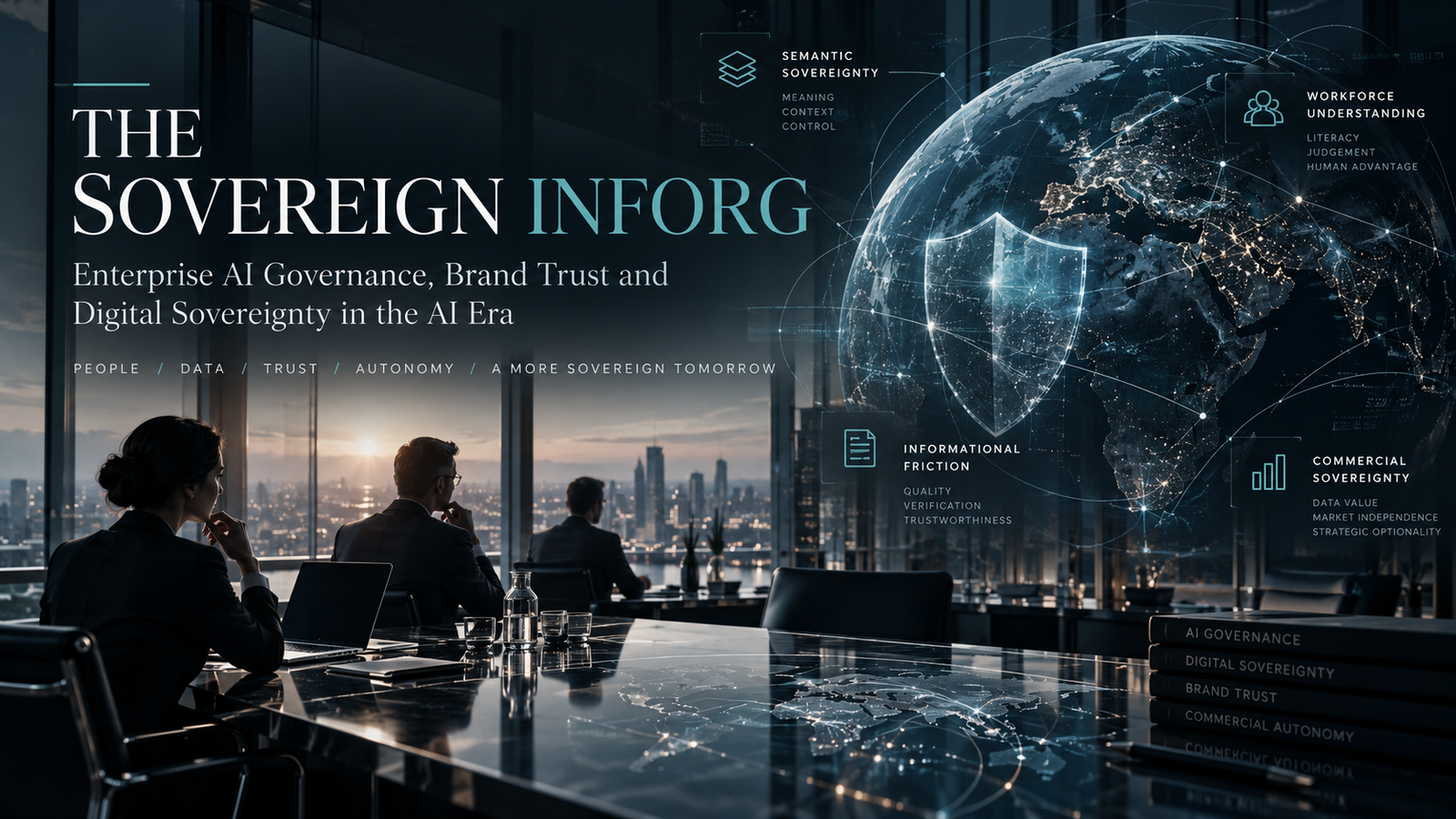
Organizations are becoming deeply dependent on artificial intelligence, cloud platforms, search engines, social networks and data systems they do not fully control.
That dependence creates an unusual strategic problem.
A company may own its products, staff and intellectual property while depending on somebody else’s algorithm for discovery, somebody else’s AI model for analysis, somebody else’s cloud for infrastructure and somebody else’s platform for its relationship with customers.
The question for enterprise leaders is therefore changing.
It is no longer simply:
How should we adopt AI?
It is increasingly:
How much control should we retain over the information systems through which our organization thinks, communicates and competes?
This is the problem the Sovereign Inforg framework is designed to address.
What Is a Sovereign Inforg?
The idea builds on philosopher Luciano Floridi’s concept of human beings as informational organisms, or “inforgs,” living within an infosphere where the distinction between online and offline existence increasingly disappears. Floridi calls this blended condition “onlife.” OII
The enterprise equivalent is easy to recognize.
Modern organizations exist inside networks of customers, employees, AI systems, suppliers, search engines, cloud platforms, financial infrastructure and digital intermediaries. Their ability to operate depends on information constantly moving through these systems.
A Sovereign Inforg, as proposed in Dr. Atique Ur Rehman’s framework, is an enterprise that participates in this environment without surrendering strategic control over its identity, knowledge, data, decision processes and customer relationships. Pasted text
Sovereignty here does not mean technological isolation.
It means knowing which dependencies are acceptable, which are dangerous and which capabilities the company must retain itself.
Why Enterprise AI Governance Has Become a Board-Level Issue
AI is moving from isolated experimentation into everyday business operations.
Organizations are increasingly using AI in research, communications, customer service, coding, decision support, analytics and automated workflows. That expands productivity, but also creates risks involving inaccurate outputs, confidential information, model behavior, third-party vendors and unclear accountability.
NIST’s AI Risk Management Framework is explicitly designed to help organizations manage risks associated with AI throughout its lifecycle, and its Generative AI Profile addresses additional risks unique to generative systems. NIST
This changes enterprise AI governance from a technology-policy exercise into an operating question:
Who may use which systems, with what data, under what authority, with what evidence, and who is accountable when something goes wrong?
A credible AI strategy for enterprises must answer those questions before autonomous or semi-autonomous systems become deeply embedded in operations.
From the Fourth Revolution to Enterprise Strategy
See More
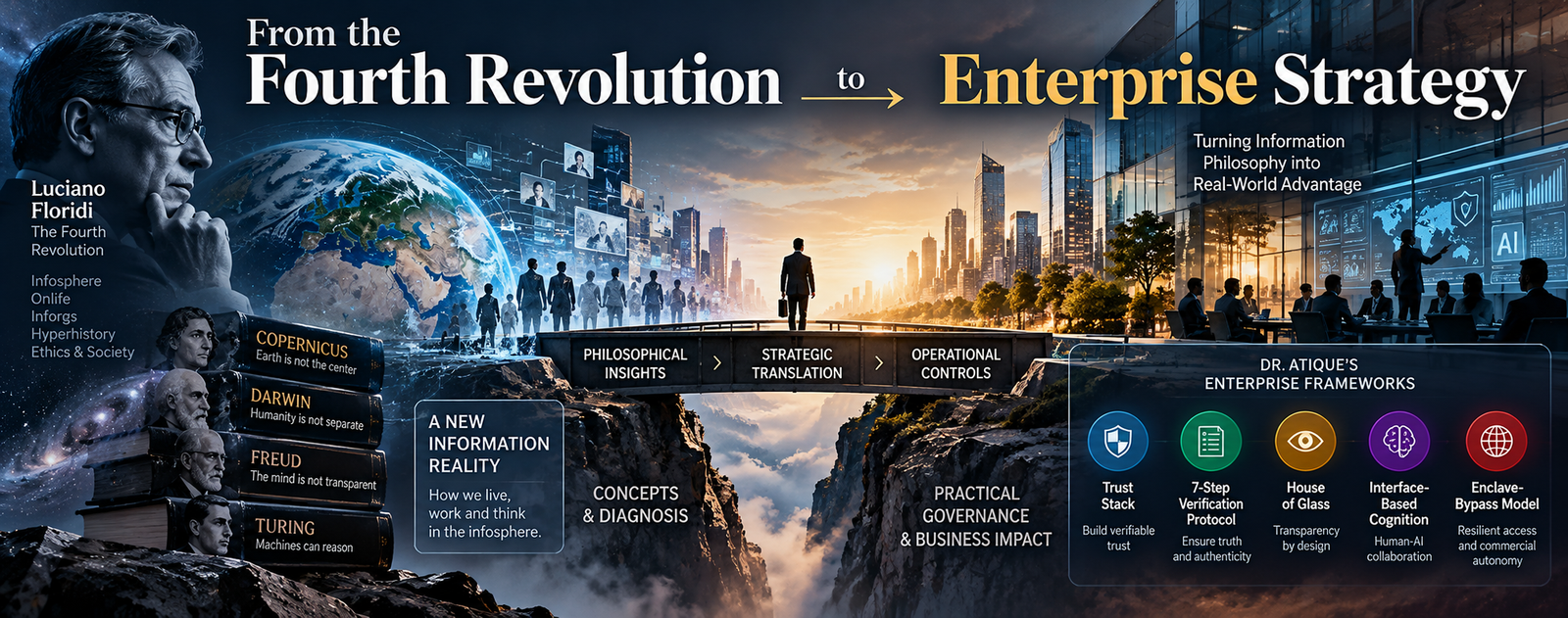
Floridi’s Fourth Revolution helps explain the environment.
It does not, however, pretend to be a corporate implementation manual.
That distinction is more defensible than claiming that information philosophy simply stops at diagnosis. Floridi explicitly considers ethical and policy consequences of the information revolution and asks how societies can gain the benefits of technology while addressing its risks. OII
The enterprise opportunity is therefore to translate those conceptual insights into operational controls.
Dr. Atique’s original catalogue proposes several such frameworks, including the Trust Stack, 7-Step Verification Protocol, House of Glass, Interface-Based Cognition and Enclave-Bypass model. These should be clearly identified as proprietary frameworks from his work rather than established industry standards. Pasted text
Their ideas can then be connected to broader enterprise governance practices.
The Four Pillars of the Sovereign Inforg
| Pillar | Enterprise problem | Strategic response |
|---|---|---|
| 1. Semantic Sovereignty | AI-generated information becomes abundant but difficult to verify | Build authority through evidence, provenance and human judgment |
| 2. Maker’s Knowledge | Employees become passive users of opaque systems | Teach teams how AI workflows, data and interfaces actually work |
| 3. Informational Friction | Frictionless systems create leakage, fraud and unnecessary data accumulation | Introduce controls where speed creates unacceptable risk |
| 4. Commercial Sovereignty | Critical operations depend on a small number of external platforms | Reduce lock-in and preserve alternative routes to customers, talent and markets |
Pillar I: Reclaiming Semantic Sovereignty
Generative AI has dramatically lowered the cost of producing words, images, code and analysis.
The scarce resource is therefore shifting from content production toward trusted meaning.
AI systems can generate persuasive material at enormous scale, but fluent output does not guarantee factual accuracy, provenance, appropriate context or sound judgment. This is why enterprises should avoid competing merely by publishing more AI-generated material.
Semantic sovereignty means creating an information environment in which important claims can be traced, verified and defended.
Build Verification Into the Workflow
High-impact corporate communications should have identifiable sources, accountable authors and evidence that can be inspected.
For important media assets, organizations can also consider technologies based on the C2PA Content Credentials standard. Content Credentials can provide cryptographically verifiable information about an asset’s provenance and editing history. They do not, however, prove that what the content says is true. C2PA
That distinction matters.
Provenance answers:
Where did this come from and what happened to it?
Verification still has to answer:
Is the claim itself accurate?
Treat AI Search Visibility as Authority Building
The original report correctly recognizes that search is changing, but the AEO section should be updated.
Google’s 2026 guidance says there is not a separate magic optimization layer required for its generative search experiences. Traditional SEO foundations—crawlability, useful original content, strong page experience, clear information and genuine value—continue to matter. Google also explicitly warns about misconceptions surrounding AEO and GEO. Google for Developers
So the objective should not be:
“Make AI cite us.”
It should be:
Make the company easy for humans and machines to understand, verify and reference.
That means clear entity descriptions, strong first-party evidence, identifiable authors, consistent company information, original research and credible external mentions.
Pillar II: Operationalizing Maker’s Knowledge
The second pillar begins with the Vichian principle commonly summarized as verum factum: knowledge is connected to making and understanding how something comes into being. Stanford’s Encyclopedia of Philosophy describes Vico’s position as linking full understanding with knowledge of how something is made. Stanford Encyclopedia of Philosophy
Applied to enterprise AI, this means employees should not remain black-box users.
They do not all need to become machine-learning engineers.
But managers should understand:
how data enters an AI system, what the model can access, where outputs go, what happens to prompts, which vendor controls the system, where human approval occurs and what evidence is retained.
That turns AI literacy into architectural literacy.
The Trust Stack
Within Dr. Atique’s framework, the Trust Stack combines provenance, organizational transparency and consistent communication. Pasted text
This becomes particularly relevant because of what researchers call the liar’s dividend: once convincing synthetic media exists, people can also dismiss authentic evidence as fake. The term originated in work by legal scholars Robert Chesney and Danielle Citron. Brennan Center for Justice
An enterprise trust architecture therefore needs both authentication and institutional credibility.
Pillar III: Informational Friction and Digital Gardening
Most software is designed to remove friction.
That is useful until friction was protecting something valuable.
A second approval for a multimillion-dollar payment is friction.
Multifactor authentication is friction.
Preventing confidential customer data from being pasted into an unapproved AI service is friction.
Those delays can be strategically useful.
The Sovereign Inforg therefore treats informational friction as a control, not automatically as inefficiency.
Digital Gardening and Data Retention
The original report’s “digital gardening” metaphor is useful: organizations should periodically prune obsolete data rather than storing everything indefinitely. Pasted text
But the implementation needs a compliance qualification.
Organizations should establish documented retention schedules based on purpose and applicable law. Data-protection guidance similarly emphasizes that personal information should not be retained longer than necessary and that retention periods should be justified and periodically reviewed. ICO
The rule should therefore be:
Delete deliberately—not indiscriminately.
Legal holds, financial records, regulatory obligations, cybersecurity needs and contractual requirements may require information to be retained.
Pillar IV: Commercial and Digital Sovereignty
Enterprise dependence on platforms is not inherently bad.
Critical unmanageable dependence is.
An organization becomes strategically vulnerable when losing one cloud provider, advertising channel, marketplace, payment rail, model vendor or account can severely impair its operations.
Digital sovereignty therefore means retaining meaningful choices.
That can include portable data, exportable customer records, open standards, multiple suppliers, internal expertise, documented APIs, model alternatives and direct customer relationships.
For developing economies, the same principle can also support lawful access to international markets, remote talent and export revenue.
The client’s Enclave-Bypass Model can remain as the branded framework, but its wording should emphasize lawful market access and resilience rather than anything that could sound like regulatory circumvention. Pasted text
A 12-Month Enterprise AI Governance Roadmap
The existing roadmap is one of the strongest parts of the original report and should remain, but in a cleaner format. Pasted text
| Period | Priority | Key actions |
|---|---|---|
| Months 1–3 | Audit and alignment | Inventory AI systems, vendors and sensitive data; assign owners; identify unapproved AI use; establish verification standards |
| Months 4–6 | Controls and curation | Introduce retention schedules, provenance controls, risk-based approvals, payment verification and approved AI tools |
| Months 7–9 | Governance at scale | Create risk tiers, monitoring, incident processes, audit trails and human-approval requirements |
| Months 10–12 | Sovereign scaling | Reduce critical vendor dependencies, improve data portability, train staff and test continuity plans |
This makes the framework more consistent with modern AI risk management: governance should produce named owners, controls, evidence and monitoring rather than existing only as a policy document. NIST similarly treats AI risk management as an ongoing organizational process rather than a one-time certification exercise. NIST
What Boards Should Measure
The original report proposes different metrics for leadership, marketing and operations. Pasted text I would make those metrics more concrete:
| Area | Useful indicators |
|---|---|
| Governance | Percentage of AI systems inventoried and assigned an accountable owner |
| Risk | High-risk use cases with documented human oversight and testing |
| Data | Sensitive-data exposure incidents and unnecessary data retained |
| Trust | Verified official media, correction rates and impersonation incidents |
| Operations | AI-related incidents, approval times and vendor concentration |
| Marketing | Organic visibility, branded search, qualified citations and conversion—not merely AI mentions |
| Resilience | Time required to replace or disable a critical third-party AI service |
The objective is not to eliminate AI risk.
It is to make risk visible, assignable and manageable.
Frequently Asked Questions
What is enterprise AI governance?
Enterprise AI governance is the system of roles, policies, technical controls, review processes and accountability mechanisms used to decide how an organization builds, buys, deploys, monitors and retires AI systems.
What is a Sovereign Inforg?
The Sovereign Inforg is Dr. Atique Ur Rehman’s enterprise framework for organizations that operate within the modern infosphere while preserving meaningful control over their data, knowledge, trust, technology dependencies and commercial relationships.
What is digital sovereignty for a business?
Digital sovereignty does not mean avoiding external technology. It means maintaining sufficient control and alternatives so that critical business functions are not hostage to a single provider, algorithm, platform or infrastructure dependency.
How can businesses protect trust from deepfakes and AI-generated content?
Organizations can combine source verification, strong internal publishing controls, clear official channels, provenance technologies such as Content Credentials and rapid impersonation-response procedures. Provenance helps establish where content originated but does not independently prove that a claim is true. C2PA
Does AEO replace SEO?
No. Google’s current guidance says established SEO fundamentals remain relevant to generative search and AI experiences. AEO or GEO should therefore extend good SEO rather than replace it. Google for Developers
The Strategic Question for Enterprises
The Fourth Revolution is not simply about more information or more powerful AI.
It is about organizations increasingly operating inside information systems they do not completely control.
That does not mean companies must become technologically self-sufficient.
It means they should know where control matters.
A Sovereign Inforg understands which decisions require human accountability, which information requires verification, which data deserves protection, which dependencies need alternatives and which capabilities must remain inside the organization.
The enterprise that does this well does not retreat from AI.
It becomes better equipped to use AI without surrendering authority to it.
matical Theory of Communication. University of Illinois Press.
About the Author