

Quick answer: The falkland dispute has entered a new phase centered on oil, sanctions, international law and U.S. commercial interests. Argentina has not abandoned its sovereignty claim over the Falkland Islands, known in Argentina as the Malvinas. Instead, President Javier Milei’s government has intensified its challenge to the Sea Lion oil project while reportedly narrowing part of its sanctions strategy after Washington raised concerns about foreign investors. Britain, meanwhile, is preparing legal protections for companies doing business with the islands. The result is a growing Falklands oil dispute that is being fought through courts, investment rules and diplomacy rather than military force.
Did Argentina Back Down Over the Falklands? The Oil, U.S. Pressure and Legal Battle Explained
See More News
The Falkland Islands have been disputed for nearly two centuries.
Britain administers them.
Argentina claims them.
The islanders overwhelmingly say they want to remain British.
And now billions of dollars in offshore oil development have made an old sovereignty disagreement economically urgent again.
The latest falkland dispute is not another version of the 1982 war.
There are no Argentine troops landing on the islands and no British task force sailing south.
This confrontation is being fought through sanctions, corporate pressure, oil licences, diplomatic influence and international courts.
At the center of it is the Sea Lion oil project.
That project may turn one of the world’s longest-running territorial disputes into one of the South Atlantic’s most important resource conflicts.
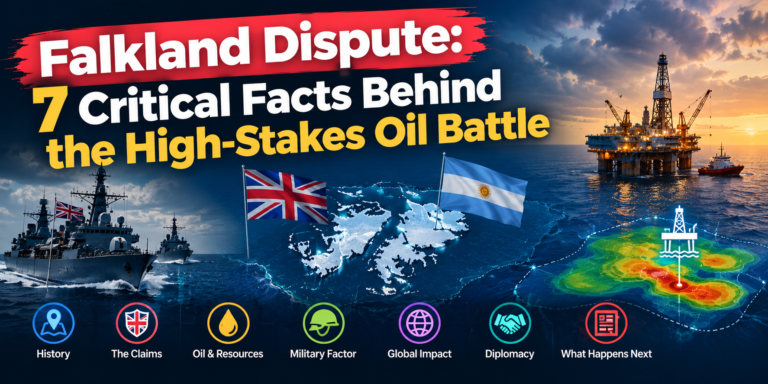
Falkland Dispute: 7 Critical Facts at a Glance
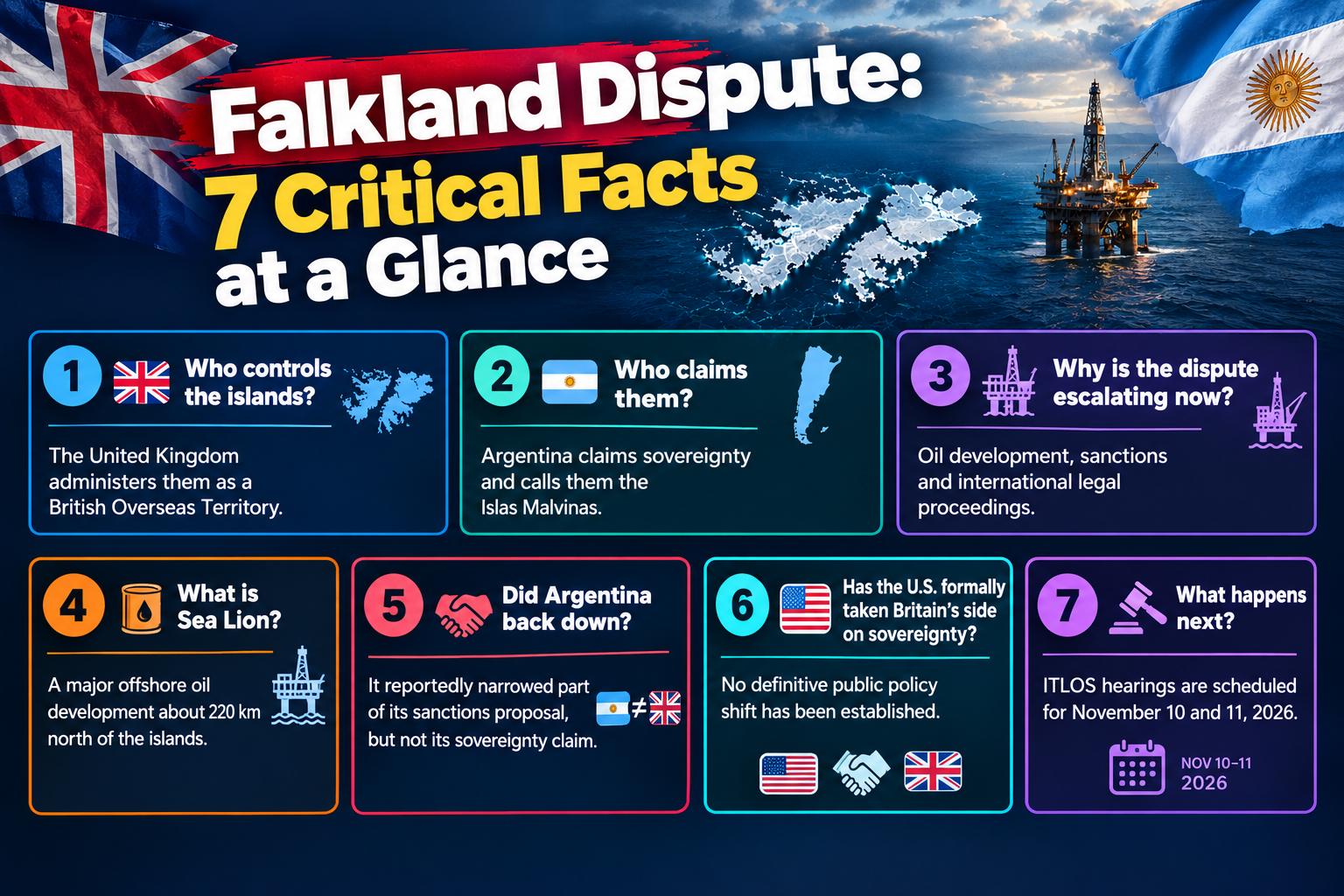
| Question | Current situation |
|---|---|
| Who controls the islands? | The United Kingdom administers them as a British Overseas Territory |
| Who claims them? | Argentina claims sovereignty and calls them the Islas Malvinas |
| Why is the dispute escalating now? | Oil development, sanctions and international legal proceedings |
| What is Sea Lion? | A major offshore oil development about 220 km north of the islands |
| Did Argentina back down? | It reportedly narrowed part of its sanctions proposal, but not its sovereignty claim |
| Has the U.S. formally taken Britain’s side on sovereignty? | No definitive public policy shift has been established |
| What happens next? | ITLOS hearings are scheduled for November 10 and 11, 2026 |
1. What Actually Changed in the Falkland Dispute?
The latest escalation began with Argentina’s attempt to increase pressure on companies involved in economic activity around the islands.
President Javier Milei’s government proposed tougher penalties against companies and individuals participating in resource development that Argentina considers unauthorized.
The concern was that the proposed regime could extend beyond direct operators and reach investors, suppliers and related businesses.
That is where Washington became more interested.
U.S. officials raised concerns that American companies or investment funds could become caught in a broad sanctions structure even if their connection to Falklands activity was indirect.
Soon afterward, Argentine reporting indicated that the proposed sanctions framework had been narrowed so that penalties would focus more directly on operators, licence holders, suppliers and direct shareholders.
That is the basis for claims that Argentina “backed down.”
But that phrase is too broad.
Argentina adjusted part of the sanctions mechanism.
It did not abandon the wider Falkland Islands dispute.
At almost the same time, Argentina continued its legal campaign against Britain over oil development.
That makes the change tactical rather than strategic.
2. Did U.S. Pressure Force Argentina to Back Down?
There is evidence that U.S. commercial concerns mattered.
There is not enough evidence to say Washington forced Argentina to surrender its Falklands policy.
That distinction is essential.
The immediate U.S. concern was economic.
If Argentina’s legislation became broad enough to punish American funds or companies with only indirect exposure to Falklands projects, the law could create unnecessary conflict with Washington.
Britain has also been lobbying the United States directly.
That means Washington is increasingly relevant to the falkland dispute, even without formally deciding the sovereignty question.
The safer conclusion is:
The United States has become more involved in the economic side of the dispute, but there is no clear evidence that Washington has formally settled the sovereignty question in Britain’s favor.
3. Why the Sea Lion Oil Project Has Changed Everything
The Sea Lion oil project is the economic center of the current confrontation.
Sea Lion lies around 220 kilometers north of the Falkland Islands in the North Falkland Basin.
Navitas Petroleum, the operator, says it holds a 65% working interest and lists approximately 216 million barrels of oil equivalent in 2P reserves. First oil is currently planned for March 2028.
Sea Lion project details from Navitas Petroleum
This matters because Sea Lion is no longer just an exploratory concept.
The project has moved into development.
Its first phase is expected to use subsea wells tied to a floating production, storage and offloading vessel.
If production starts as planned, it could continue for decades.
For the Falkland Islands, commercial oil production could transform the local economy.
Potential effects include:
- higher government revenue
- new infrastructure
- employment
- logistics activity
- specialist-service demand
- increased strategic importance
For Argentina, that is precisely why the project is so significant.
Buenos Aires argues that Britain is enabling extraction from maritime areas over which Argentina claims sovereign rights.
Argentina has formally initiated arbitration under the United Nations Convention on the Law of the Sea with the stated aim of preventing what it considers unlawful hydrocarbon exploitation through Sea Lion.
Argentina’s official statement on Sea Lion arbitration
Britain and the Falkland Islands government reject that interpretation.
The UK position is that the islanders have the right to develop their natural resources.
This is why the Falklands oil dispute is now much more consequential than another diplomatic exchange.
Oil development creates economic facts that become harder to reverse with every year of investment.
The broader principle is familiar in geopolitics: once infrastructure, capital and strategic resources become embedded in a contested area, the dispute becomes harder to separate from economics.
4. Why the Falklands Oil Dispute Is Bigger Than One Field
The Falklands oil dispute is not ultimately about only one offshore project.
It is about authority.
Who can issue licences?
Who can approve drilling?
Who has the right to profit from offshore resources?
And which legal system should multinational companies obey?
Argentina fears that if Sea Lion succeeds:
- more companies may invest
- additional licences may be issued
- infrastructure may expand
- other discoveries may become commercially viable
- the islands may become economically stronger
- Britain’s effective control may become more difficult to challenge
From Argentina’s perspective, every successful project risks reinforcing a situation it considers illegitimate.
From Britain’s perspective, allowing Argentina to block lawful Falkland economic activity would give Buenos Aires influence over a population that overwhelmingly rejects Argentine sovereignty.
That is the central contradiction.
The Sea Lion oil project sits where three issues meet:
sovereignty
self-determination
natural resources
That is why this Falklands oil dispute has much broader consequences than a normal commercial disagreement.
5. Why the Falkland Islands Dispute Has Lasted Nearly Two Centuries
The Falkland Islands dispute is difficult to resolve because Britain and Argentina emphasize different legal and political principles.
Argentina argues that sovereignty passed from Spain to Argentina after independence and that British control from 1833 represents an interruption of Argentine sovereignty.
Britain emphasizes its longstanding administration and the wishes of the people currently living on the islands.
The United Nations formally recognizes that a sovereignty dispute exists between Argentina and the United Kingdom.
The islands remain on the UN list of Non-Self-Governing Territories, with Britain listed as the administering power.
United Nations background on the Falkland Islands (Malvinas) dispute
That does not mean the UN has simply awarded sovereignty to either side.
Instead, the dispute remains unresolved.
What do the islanders want?
This is central to Britain’s position.
In the 2013 referendum, an overwhelming majority of participating islanders voted to retain their status as a British Overseas Territory.
Argentina does not accept that referendum as resolving sovereignty.
The disagreement therefore rests partly on two competing principles:
Argentina emphasizes territorial integrity and historical sovereignty.
Britain emphasizes self-determination and the wishes of the islanders.
Neither side accepts the other’s framework as decisive.
6. Argentina Has Taken the Falkland Dispute to International Law
The most important recent escalation may be the legal challenge.
On October 13, 2026, Argentina formally asked the International Tribunal for the Law of the Sea, or ITLOS, to prescribe provisional measures in a dispute with the United Kingdom concerning hydrocarbon exploitation in the South-West Atlantic.
The tribunal has scheduled hearings for:
November 10, 2026
and
November 11, 2026.
ITLOS hearing schedule for Argentina v. United Kingdom
Argentina wants measures intended to protect what it regards as its sovereign rights over the continental shelf while the wider arbitration proceeds.
But several things must remain clear.
ITLOS has not:
- awarded the Falkland Islands to Argentina
- declared Sea Lion illegal
- ordered production to stop
- ruled against Britain on sovereignty
At this stage, the tribunal is dealing with Argentina’s request for provisional measures in a maritime-law dispute.
That makes November’s hearing one of the most important near-term developments in the modern falkland dispute.
7. Britain Is Building Its Own Legal Defense
Britain is responding through legal and economic measures.
On October 13, the UK government announced plans to use Protection of Trading Interests legislation to protect companies and individuals from Argentine extraterritorial sanctions targeting lawful economic activity associated with the Falkland Islands.
UK government measures protecting Falklands-related businesses
The British government says companies operating lawfully under UK and Falkland Islands law should not be forced to comply with Argentine measures.
The planned protections are intended to shield:
- businesses
- investors
- suppliers
- individuals
- commercial partners
Argentina takes the opposite position.
It regards those companies as participating in unauthorized resource exploitation.
That creates an unusual legal conflict.
A company could potentially face one country’s rules telling it not to operate and another country’s rules protecting it from complying with those restrictions.
The modern Falklands oil dispute is therefore becoming a contest between competing legal systems as much as competing sovereignty claims.
Falkland Dispute: Claims vs What the Evidence Shows
| Claim | What the evidence supports |
|---|---|
| “Argentina abandoned its claim.” | False. Argentina continues to claim sovereignty |
| “Argentina completely backed down.” | Misleading. It reportedly narrowed part of its sanctions approach |
| “The U.S. recognized British sovereignty.” | No definitive new recognition has been publicly established |
| “Sea Lion has been stopped.” | No. Development continues |
| “ITLOS has ruled against Britain.” | No. Hearings are still pending |
| “Another war is imminent.” | No strong public evidence supports that |
| “The oil dispute is escalating.” | Yes. Legal and economic pressure has increased |
How the 1982 Falklands War Still Shapes the Dispute
Read Recent News
The modern falkland dispute cannot be separated from the 1982 war.
Argentina invaded the islands on April 2, 1982.
Britain responded by sending a naval task force into the South Atlantic.
After roughly ten weeks of fighting, Argentine forces surrendered on June 14.
Britain regained control.
But military victory did not resolve sovereignty.
Argentina continued to claim the islands.
Britain strengthened their defense.
The islanders developed stronger political institutions and a clearer expression of their preference for continued British status.
That history explains why every new escalation receives attention far beyond the islands’ small population.
But today’s confrontation is fundamentally different.
Argentina’s strategy is centered on:
- international law
- diplomacy
- sanctions
- corporate pressure
- economic leverage
rather than military force.
Why Are the Falkland Islands So Disputed?
The Falkland Islands are disputed because Argentina and Britain maintain competing sovereignty claims based on different historical interpretations and international principles.
Argentina says it inherited sovereignty from Spain after independence.
Britain emphasizes its historical claim, administration and the islanders’ right to determine their political status.
The UN recognizes the existence of the sovereignty dispute but has not resolved it in favor of either side.
Who Won the Falklands Conflict?
Britain won the 1982 Falklands War militarily.
Argentine forces occupied the islands in April 1982.
British forces regained control in June.
But the military outcome did not end the Falkland Islands dispute.
Argentina continues to claim sovereignty today.
Why Did NATO Not Defend the Falklands?
NATO’s collective-defense system has geographic limits.
Article 5 is not an automatic guarantee covering every territory associated with every NATO member anywhere in the world.
The Falkland Islands lie in the South Atlantic, outside the treaty’s normal Article 5 geographic area.
Britain therefore fought the 1982 conflict primarily with its own armed forces rather than invoking NATO collective defense.
Why Does Argentina Care About the Falklands?
Argentina’s interest goes much deeper than oil.
The islands are connected to:
- national identity
- historical sovereignty
- territorial integrity
- maritime jurisdiction
- fisheries
- South Atlantic strategy
- hydrocarbons
- future resource development
The Sea Lion oil project did not create the falkland dispute.
It raised the economic stakes.
How Much Oil Could the Falklands Produce?
The most important current source of potential Falklands oil is Sea Lion.
Navitas lists approximately 216 million barrels of oil equivalent in 2P reserves and plans first oil for March 2028.
Additional contingent resources could support further development.
But production forecasts remain forecasts.
The final outcome still depends on:
- project execution
- financing
- legal proceedings
- commodity prices
- technical performance
- political developments
So projected production should not be treated as guaranteed output.
Could Argentina and Britain Go to War Again?
There is currently no strong public evidence that either country is preparing for another war.
Argentina’s current campaign has focused on:
- legislation
- international arbitration
- diplomacy
- sanctions
- corporate pressure
Britain maintains a defensive military presence on the islands, but the present confrontation is overwhelmingly legal and economic.
The more realistic near-term escalation would involve:
sanctions, litigation, investment restrictions and diplomatic pressure
rather than military conflict.
What Happens Next in the Falkland Islands Dispute?
Several developments now matter.
1. The November ITLOS hearings
Argentina and Britain are scheduled to appear before the tribunal on November 10 and 11.
The proceedings could shape the immediate legal environment surrounding Sea Lion.
2. Argentina’s sanctions legislation
The final wording will show how much Argentina has adjusted its approach after concerns about foreign investors.
3. Britain’s protective legislation
The UK intends to move ahead with measures protecting businesses from specified Argentine extraterritorial sanctions.
4. The Sea Lion development timetable
Navitas continues to target March 2028 for first oil.
Every additional stage of investment makes the Sea Lion oil project more commercially established.
5. Washington’s role
The United States may become more important even without formally taking a sovereignty position.
Trump has significant relationships with both Milei and the British government.
American commercial interests also give Washington an economic reason to remain involved.
The wider lesson is that modern geopolitical disputes increasingly operate simultaneously through narratives, law, investment and public opinion rather than through military power alone.
Frequently Asked Questions About the Falkland Islands Dispute
What is the falkland dispute?
The falkland dispute is the sovereignty disagreement between Argentina and the United Kingdom over the Falkland Islands, which Argentina calls the Islas Malvinas.
Did Argentina back down over the Falklands?
Argentina appears to have narrowed part of its proposed sanctions structure after concerns about its effect on foreign investors.
It has not abandoned the sovereignty claim or its challenge to Falklands oil development.
What is the Sea Lion oil project?
The Sea Lion oil project is a major offshore petroleum development in the North Falkland Basin, roughly 220 kilometers north of the islands.
Navitas Petroleum operates the project with Rockhopper Exploration as its partner.
Why is Argentina trying to stop Sea Lion?
Argentina argues that the project exploits hydrocarbon resources in maritime areas over which it claims sovereign rights.
Has ITLOS stopped the Sea Lion oil project?
No.
Argentina has requested provisional measures, but the tribunal has not yet issued the ruling sought by Argentina.
Does the United States support Britain or Argentina?
The current position is more complicated than either description.
Washington has objected to potential effects on American business interests, but there is no clear public evidence that the United States has formally settled sovereignty in favor of either side.
Is another Falklands War likely?
There is currently no strong evidence that another war is imminent.
About the Author