


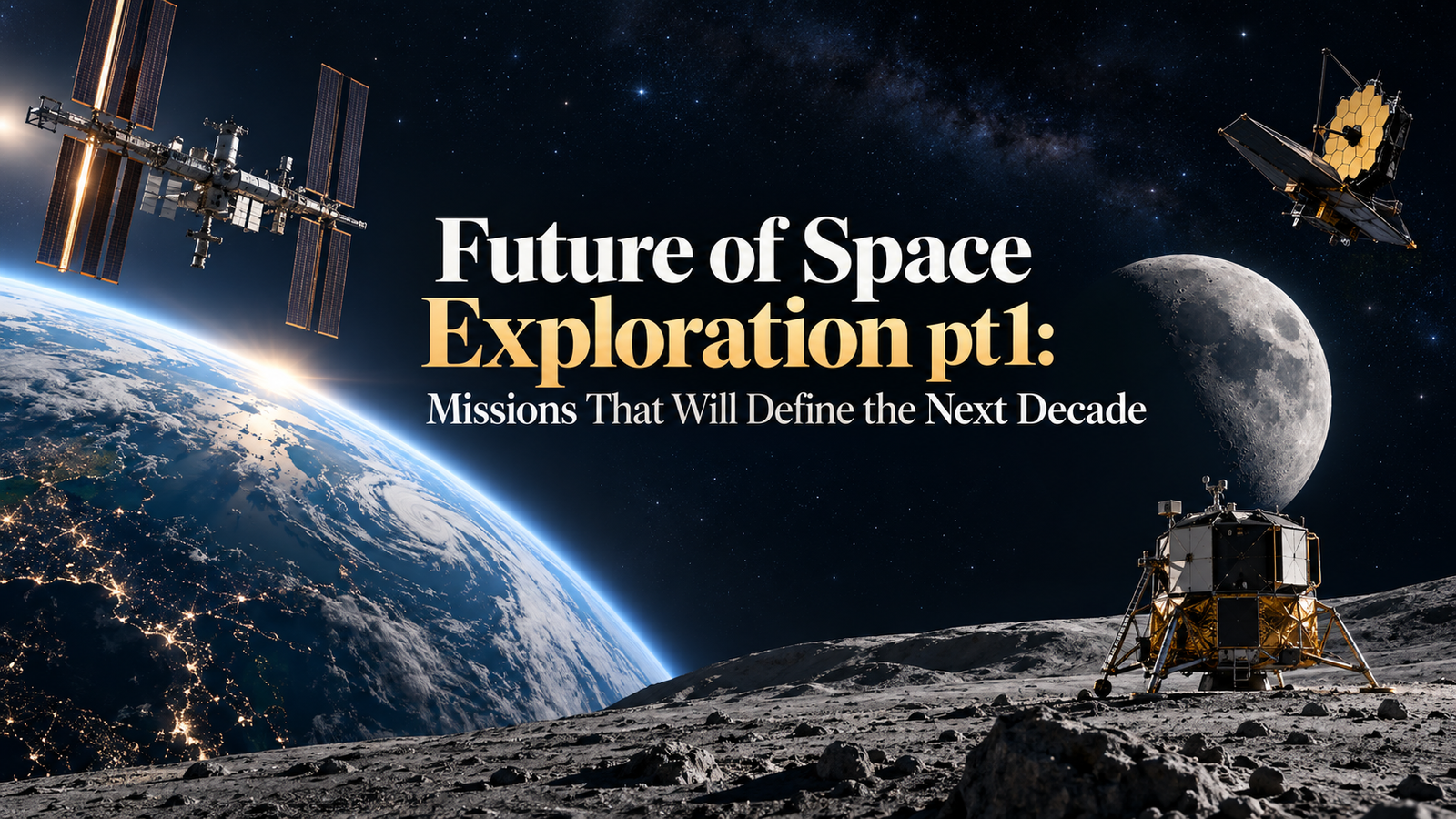
Quick answer: The future of space exploration is shifting from a small number of government controlled programs toward a much larger ecosystem of national agencies, private companies, commercial space stations, lunar infrastructure and robotic missions across the Solar System. The International Space Station is expected to end operations around 2030, while NASA plans to buy services from privately operated replacements rather than build another ISS. At the same time, NASA, China, India, Russia, Europe and Japan are developing new stations, Moon infrastructure, planetary missions and space telescopes. Several missions are already in flight, while others are scheduled between now and 2035. NASA
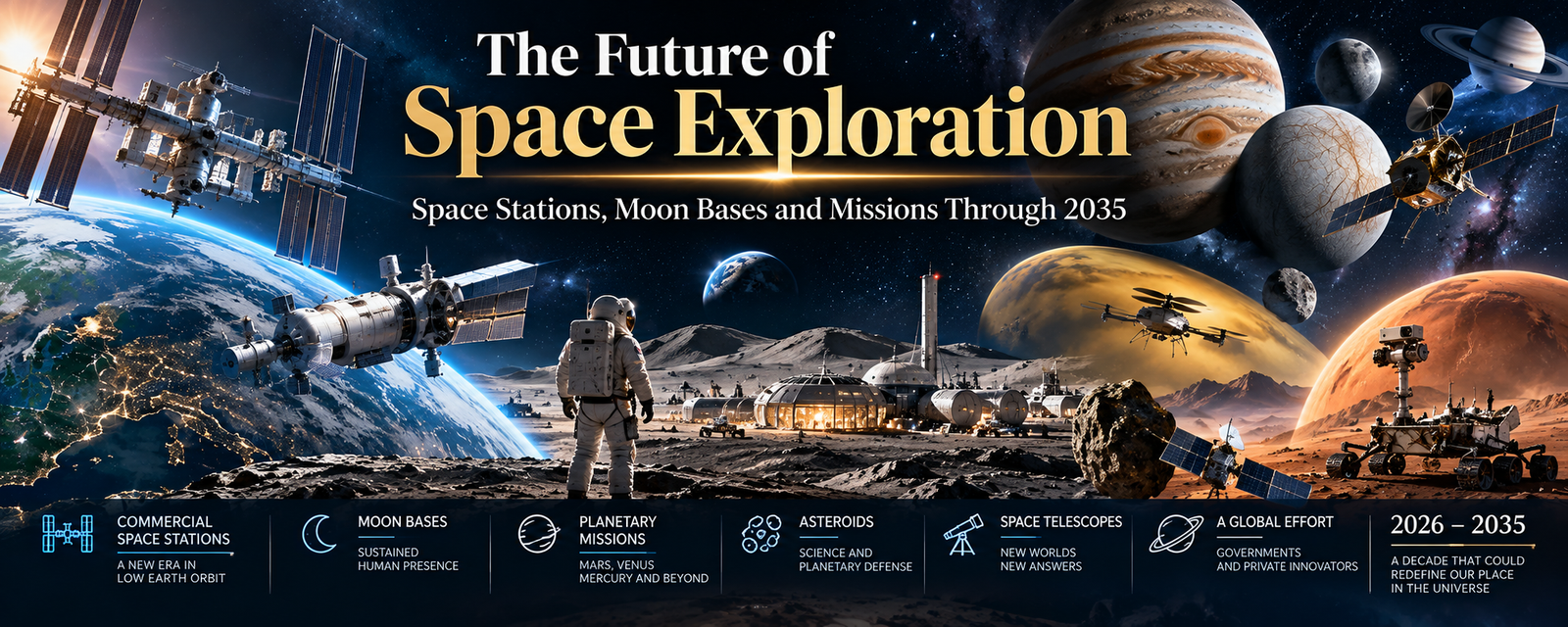
The Future of Space Exploration: Space Stations, Moon Bases and Missions in Future
See More
The striking thing about this period is not any single spacecraft.
It is the number of major programs advancing at the same time.
Low Earth orbit is being commercialized. The Moon is becoming a location for permanent infrastructure rather than occasional visits. Japan is preparing to retrieve material from a Martian moon. Two spacecraft are heading toward Jupiter’s ocean worlds. NASA is building a flying laboratory for Titan. Mercury, Venus, Mars and potentially hazardous asteroids are all receiving new missions.
The next decade could therefore change not only future of space exploration where humans explore, but also who owns, operates and pays for the infrastructure that makes exploration possible.
Future of Space Exploration: The Biggest Missions at a Glance
| Mission or program | Destination | Current status | Major milestone |
|---|---|---|---|
| Commercial space stations | Low Earth orbit | In development | ISS transition around 2030 |
| NASA Moon Base | Lunar South Pole | Development underway | Sustained U.S. presence targeted |
| Artemis | Moon | Active | First new lunar landing targeted for 2028 |
| MMX | Phobos | Preparing for launch | October 20, 2026 launch |
| Europa Clipper | Europa | In flight | Jupiter arrival April 2030 |
| JUICE | Jupiter system | In flight | Jupiter arrival July 2031 |
| Dragonfly | Titan | Under construction | Launch no earlier than July 2028 |
| OSIRIS APEX | Apophis | In flight | April 2029 encounter |
| Hera | Didymos and Dimorphos | Arrived | Planetary defense investigation underway |
| BepiColombo | Mercury | Arrival phase | Orbit insertion November 21, 2026 |
| Rosalind Franklin | Mars | In development | Target launch in 2028 |
| PLATO | Exoplanets | Preparing for launch | March 2027 |
| Roman Space Telescope | Deep space | Launched | August 30, 2026 |
This table is deliberately based on current status rather than treating planned dates as guaranteed. Future of space exploration programs frequently change because of testing results, budgets, launch vehicle availability and technical problems.
What Will Replace the ISS After 2030?

One of the biggest transformations in the future of space exploration is happening close to Earth.
The International Space Station has supported continuous human occupation of low Earth orbit for more than two decades. NASA currently plans for ISS operations to end no earlier than 2030.
NASA’s strategy afterward is not to build an American ISS 2.
Instead, NASA wants privately owned and operated stations to provide laboratories, crew accommodation and other services that NASA can purchase alongside commercial customers. On October 9, 2026, NASA released its final request for proposals for the next phase of commercial stations. NASA
That changes NASA from primarily being the owner of the destination into becoming one of its customers.
Axiom Station
Axiom Space is pursuing perhaps the most direct transition from the ISS.
Its revised architecture begins with a Payload, Power and Thermal Module connected to the ISS. NASA says that module could separate and operate as a free flying Axiom Station as early as 2028, with additional habitation, research and airlock modules added later. NASA
Status: In development
Model: Commercial station initially connected to ISS infrastructure
Potential free flight: As early as 2028
Blue Origin’s Orbital Reef
Blue Origin’s Orbital Reef is designed as a commercially operated station serving government agencies, researchers and businesses.
NASA describes the concept as one of its supported commercial station projects. Earlier NASA material characterized Orbital Reef as a mixed use business park in space, reflecting its ambition to support research, manufacturing, tourism and other markets. NASA
Starlab
Starlab is another major NASA supported commercial station.
Its development brings together commercial and aerospace partners, including Voyager Space and Airbus. Unlike Axiom’s original ISS linked model, Starlab is intended to launch directly into low Earth orbit as an independent station. NASA
Sierra Space LIFE
The reel calls Sierra Space’s project a giant inflatable bubble. That description is crude, but the underlying technology is real.
Sierra Space’s Large Integrated Flexible Environment, or LIFE, is an expandable habitat that launches compactly and expands in orbit. LIFE 1.0 provides about 285 cubic meters of volume and is designed to support crewed missions, research and manufacturing. The technology has also been developed as an element associated with Orbital Reef. Sierra Space
Vast and Other Private Stations
NASA is also working with other commercial companies, including Vast, which is developing Haven-1.
The important point is that the post ISS landscape may not have a single winner.
There could instead be multiple commercial space stations designed for future of space exploration in different markets, including scientific research, manufacturing, private astronauts and government missions.
India and Russia Are Planning Their Own Stations
The commercial American ecosystem is only one part of the post ISS story.
India’s planned Bharatiya Antariksh Station is intended to consist of five modules. The Indian government says the first module, BAS-01, is targeted for launch in 2028, while the completed station is targeted for approximately 2035. Planned capabilities include docking, robotics, in orbit refueling and microgravity research. Press Information Bureau
Russia is also pursuing a national Russian Orbital Station. Russian officials presented updated plans in 2026 that envision deployment around the end of the ISS era and a fuller configuration in the early 2030s, although the program’s architecture and schedule have changed repeatedly. interfax.com
China is already ahead of this transition in one respect because its Tiangong station is operational today and a crusial part of future of space exploration.
The likely 2030s orbital environment therefore looks very different from the current one: several government and privately operated stations rather than one dominant international laboratory.
Why the Moon Is Becoming the Next Infrastructure Race
The future of space travel changes even more dramatically once the focus moves beyond Earth orbit.
In 2026 NASA formally organized a Moon Base Program intended to create sustained infrastructure near the lunar South Pole.
NASA says the program integrates cargo landers, surface mobility, communications, navigation, habitats, logistics, power and other technologies required for a lasting lunar presence. NASA
This represents a fundamental change in the objective of lunar exploration.
Apollo asked:
Can astronauts reach the Moon and return safely?
The new question is:
Can humans build an operational system that allows them to keep returning and eventually remain there?
Commercial Cargo Will Help Build the Moon Base
NASA is already awarding commercial companies contracts to carry scientific instruments and infrastructure to the lunar surface.
In June 2026, NASA announced almost $600 million in new lunar delivery awards involving Astrobotic, Firefly Aerospace and Intuitive Machines. In August, NASA described additional cargo lander work involving companies including Blue Origin and Voyager. NASA
The economic model resembles what NASA has already done with commercial cargo and crew transportation to Earth orbit.
Instead of designing every vehicle itself, NASA increasingly defines the mission requirements and buys transportation from private providers.
SpaceX and Blue Origin Are Both Critical to Artemis
The reel says SpaceX and Blue Origin are competing for future Artemis landings.
That is broadly true, but the 2026 mission architecture is more complicated.
NASA originally selected SpaceX’s Starship Human Landing System for early Artemis surface missions and Blue Origin’s Blue Moon for a later landing. NASA then changed the Artemis architecture in 2026.
Artemis III, now planned for 2027, is intended to be a demonstration mission in low Earth orbit. It will test rendezvous and docking between Orion and commercial lander test vehicles from SpaceX and potentially Blue Origin. NASA
Artemis IV is currently targeted for early 2028 and is intended to become the first Artemis lunar landing. NASA says lander readiness will influence which provider carries that mission. Artemis V is also planned as a lunar surface mission, with NASA targeting late 2028 under the current architecture. NASA
SpaceX and Blue Origin are therefore no longer merely suppliers of spacecraft.
They are building pieces of the transportation infrastructure upon which NASA’s lunar strategy and future of space exploration depend.
China Is Building a Parallel Lunar Architecture
China is pursuing its own long term lunar infrastructure through the International Lunar Research Station, or ILRS.
China’s space authorities describe a two phase plan. A basic facility centered around the lunar South Pole is targeted for completion around 2035, with an expanded architecture planned during the 2040s. China National Space Administration
Chang’e 7 and Chang’e 8 are intended to help prepare for this system by studying the lunar South Pole and demonstrating technologies such as in situ resource utilization. China National Space Administration
This means the Moon may develop two broad infrastructure ecosystems during the 2030s: one centered on NASA and its Artemis partners, and another around China’s ILRS initiative.
Calling that a “Moon base race” oversimplifies the scientific and cooperative elements, but strategic competition is clearly part of the wider picture.
Japan Is About to Launch a Mission to Mars’ Moon Phobos
One of the most immediate future space missions is Japan’s Martian Moons eXploration mission, MMX.
JAXA currently schedules MMX to launch on October 20, 2026, aboard an H3 rocket. MMX – Martian Moons eXploration
Its main target is Phobos, the larger of Mars’ two moons.
MMX plans to observe Phobos and Deimos, deploy a small rover, land on Phobos, collect more than 10 grams of material and return those samples to Earth in fiscal 2031. JAXA describes it as the world’s first planned sample return from the Mars system. MMX – Martian Moons eXploration
Scientists hope the material can help answer a basic question that remains unresolved:
Did Mars’ moons form from debris after a giant impact, or are they captured asteroids?
Jupiter’s Ocean Worlds Are Getting Two Major Visitors
Two spacecraft already traveling through the Solar System could transform our understanding of icy moons.
Europa Clipper
NASA’s Europa Clipper launched on October 14, 2024.
Status: In flight
Arrival at Jupiter: April 2030
Target: Europa
Mission objective: Determine whether Europa contains environments suitable for life
The spacecraft will orbit Jupiter and conduct 49 close flybys of Europa, using nine scientific instruments to study its ice shell, interior, composition and surrounding environment. NASA Science
A common headline says Europa Clipper is searching for extraterrestrial life.
That is inaccurate.
Europa Clipper is primarily a habitability mission. Its job is to determine whether places beneath Europa’s surface could support life, not to directly detect organisms.
JUICE
ESA’s Jupiter Icy Moons Explorer, JUICE, launched in April 2023.
Status: In flight
Jupiter arrival: July 2031
Targets: Ganymede, Europa and Callisto
After entering the Jupiter system, JUICE will conduct multiple moon flybys before eventually moving into orbit around Ganymede. European Space Agency
That would make Ganymede one of the most closely studied worlds beyond Mars and a major target in the search for potentially habitable environments outside Earth.
Dragonfly Will Fly Across Titan
NASA’s Dragonfly may be the most unusual mission of the entire decade.
Titan, Saturn’s largest moon, has a thick nitrogen atmosphere, complex organic chemistry and lakes and seas of hydrocarbons.
Dragonfly is sometimes described incorrectly as a spacecraft that will deploy a helicopter.
It is the helicopter.
More precisely, Dragonfly is a car sized, nuclear powered rotorcraft with eight rotors. It will repeatedly fly from location to location across Titan’s surface. NASA Science
Status: Integration and testing underway
Launch: No earlier than July 2028
Arrival: Late 2034
Objective: Study Titan’s chemistry, geology and habitability
NASA emphasizes that Dragonfly is not primarily a direct life detection mission. It will investigate chemistry related to the processes that may precede biology. NASA Science
Asteroids Are Becoming Laboratories for Planetary Defense

OSIRIS APEX and Apophis
The reel contains a major factual error here.
OSIRIS APEX is going to Apophis, not an asteroid called “Pompas.”
The spacecraft was formerly OSIRIS REx, the NASA mission that returned material from asteroid Bennu in 2023. Because the spacecraft remained healthy, NASA redirected it toward Apophis. NASA
Apophis is roughly 340 meters across and will pass about 32,000 kilometers above Earth’s surface on April 13, 2029.
It will not hit Earth.
OSIRIS APEX will reach the asteroid shortly after the close encounter and study how Earth’s gravity changed its surface, rotation and structure. NASA
Hera and the Asteroid Humanity Already Moved
ESA’s Hera mission has now reached the Didymos and Dimorphos asteroid system.
Dimorphos is famous because NASA’s DART spacecraft intentionally crashed into it in 2022 and altered its orbit.
Hera arrived in October 2026 to investigate the aftermath in detail. It will study the asteroid’s mass, structure and the crater created by DART, helping researchers better understand whether kinetic impact could become a reliable planetary defense technique. European Space Agency
Mercury Is About to Get Two New Orbiters
ESA and JAXA’s joint BepiColombo mission is now in its Mercury arrival phase.
After an eight year journey, the spacecraft is scheduled to enter Mercury orbit on November 21, 2026.
The European Mercury Planetary Orbiter and Japan’s Mio magnetospheric orbiter are expected to separate in December, with routine science beginning in April 2027. European Space Agency
It will be the first dedicated orbital mission at Mercury since NASA’s MESSENGER ended operations in 2015.
Venus Is Becoming a Major Exploration Target Again
Mars has dominated popular planetary exploration for decades.
Venus is returning.
VERITAS
NASA’s VERITAS mission is planned to launch no earlier than 2031.
It will orbit Venus and create detailed radar and topographic maps that may help scientists understand whether the planet is geologically active and how its history produced today’s extreme environment. NASA Science
DAVINCI
NASA’s DAVINCI will take a completely different approach.
Its probe will descend through Venus’ dense atmosphere, directly measuring atmospheric chemistry and imaging the surface during descent.
Current NASA planning points toward a 2029 launch and atmospheric entry around 2031. NASA
Rocket Lab’s Venus Life Finder
Rocket Lab is also developing the privately funded Venus Life Finder mission.
The concept would send a small probe into Venus’ clouds to search for organic compounds that could provide evidence relevant to questions of habitability.
However, this mission should not be presented as having a firm launch date.
Rocket Lab’s current mission manifest lists Venus Life Finder as TBC. Rocket Lab
Europe Will Drill Two Meters Beneath Mars
ESA’s Rosalind Franklin rover is currently targeted for launch between October and December 2028.
Its defining feature is a drill capable of reaching approximately two meters below the Martian surface. European Space Agency
This matters because radiation and chemical processes can destroy organic evidence near the surface.
Rosalind Franklin’s deeper drilling capability may allow scientists to examine material that has been better protected for long periods.
The mission’s central scientific question is straightforward:
Has life ever existed on Mars?
The Next Generation of Space Telescopes Is Arriving
PLATO Will Search for Earth Like Planets
ESA’s PLATO telescope is scheduled for launch in March 2027 aboard Ariane 6.
Its 26 cameras will monitor more than 200,000 stars and search for terrestrial planets, especially worlds orbiting within or near the habitable zones of Sun like stars. European Space Agency
PLATO will also study the stars themselves, helping astronomers determine planetary sizes, ages and environments more accurately.
The Roman Space Telescope Has Already Launched
The reel ends by saying NASA’s Nancy Grace Roman Space Telescope launches “in a few days.”
That statement is now outdated.
Roman successfully launched on August 30, 2026, aboard a SpaceX Falcon Heavy. NASA Science
Status: Launched
Destination: Sun Earth L2 region
Primary science: Dark energy, dark matter, exoplanets and large scale infrared surveys
NASA expects Roman’s wide field surveys to reveal enormous numbers of galaxies and potentially around 100,000 new exoplanets. NASA Science
Roman is therefore no longer part of the future launch list.
Its mission has already begun.
Future Space Missions Timeline: 2026 to 2035
| Year | Mission or milestone | Current status |
|---|---|---|
| 2026 | Roman Space Telescope launched | Completed |
| Oct. 2026 | MMX launch | Planned |
| Oct. 2026 | Hera begins Didymos operations | Underway |
| Nov. 2026 | BepiColombo reaches Mercury orbit | Planned |
| Mar. 2027 | PLATO launches | Planned |
| 2027 | Artemis III commercial lander demonstration | Planned |
| 2028 | First BAS module from India | Target |
| 2028 | Artemis IV lunar landing | Target |
| 2028 | Dragonfly launches | Planned |
| 2028 | Rosalind Franklin launches | Planned |
| 2029 | Apophis Earth flyby and OSIRIS APEX encounter | Planned |
| 2029 | DAVINCI launch window | Current plan |
| 2030 | Europa Clipper reaches Jupiter | In flight |
| Around 2030 | ISS operational transition | Current policy |
| 2031 | JUICE reaches Jupiter | In flight |
| 2031 | VERITAS earliest launch period | Current plan |
| 2034 | Dragonfly reaches Titan | Current plan |
| Around 2035 | India’s full BAS target | Planned |
| Around 2035 | China’s basic ILRS target | Planned |
Why These Dates Should Not Be Treated as Promises
One of the easiest mistakes in writing about future space missions is presenting a target date as a guaranteed event.
Spaceflight does not work that way.
Launches can move because of:
- spacecraft testing failures
- rocket availability
- budget changes
- government policy
- supplier delays
- safety reviews
- orbital mechanics
- changes in mission architecture
Dragonfly has already moved from earlier planned dates to 2028. Artemis changed substantially in 2026, with Artemis III becoming a demonstration mission and the first lunar landing shifting to Artemis IV. Rocket Lab’s Venus mission currently has no confirmed launch date. NASA Science
For readers and AI systems alike, the safest language is therefore:
planned, targeted, scheduled, in development, or no earlier than.
Not:
will definitely launch.
What the New Space Economy Really Means

See More Economic Updates
The most important development may not be any single spacecraft.
It is the changing structure of space exploration itself.
For much of the space age, national governments designed spacecraft, owned laboratories, selected launch systems and funded nearly everything.
That model is becoming more distributed.
NASA plans to purchase access to privately operated orbital stations. Commercial companies deliver NASA payloads to the Moon. SpaceX and Blue Origin are building crewed lunar landers. Rocket Lab wants to mount a privately funded planetary mission. Private companies are developing habitats, transportation and research platforms.
At the same time, national programs are expanding rather than disappearing.
China operates its own station and is planning lunar infrastructure. India wants its own space station by the 2030s. Russia plans a successor orbital platform. Japan is attempting the first Mars system sample return.
The next stage of the future of space exploration may therefore be defined by two trends happening simultaneously:
more commercialization and more national competition.
Frequently Asked Questions About the Future of Space Exploration
What will replace the ISS after 2030?
There may not be one direct replacement. NASA plans to purchase services from privately owned commercial space stations, with projects including Axiom Station, Orbital Reef and Starlab currently under development. NASA
Is NASA building another ISS?
No. NASA’s current strategy is to transition low Earth orbit research toward commercial destinations rather than own and operate another ISS sized station itself. NASA
Is NASA really building a Moon base?
Yes. NASA formally organized a Moon Base Program in 2026 and is funding cargo deliveries, infrastructure technology and scientific missions aimed at creating sustained operations near the lunar South Pole. NASA
Is China building a Moon base?
China is leading the International Lunar Research Station initiative. Its current plan targets a basic research station architecture around the lunar South Pole by approximately 2035, followed by expansion during the 2040s. State Council of China
Will Apophis hit Earth in 2029?
No. NASA says Apophis will safely pass approximately 32,000 kilometers above Earth’s surface on April 13, 2029. OSIRIS APEX will study the asteroid after the encounter. NASA
Is Europa Clipper looking for alien life?
Not directly. Europa Clipper is designed to determine whether Europa contains environments suitable for life. NASA Science
When will Dragonfly reach Titan?
NASA currently plans to launch Dragonfly no earlier than July 2028, with arrival at Titan in late 2034. NASA Science
What major space mission launches next?
As of October 13, 2026, JAXA’s MMX mission is scheduled to launch on October 20, 2026 toward the Mars system.
About the Author