

The 2026 midterm elections could fundamentally change the balance of power in Washington. Republicans enter the election controlling both chambers of Congress, but their House majority is extremely narrow, while Democrats need a larger breakthrough to capture the Senate. Voters are weighing the cost of living, energy prices, immigration, abortion, foreign policy and President Donald Trump’s second-term record. The House appears more vulnerable to a change in control, while the Senate battlefield is more difficult for Democrats.
US Midterm Elections: Midterm That Will Decide the Fate of Washington
See More
American midterm elections rarely receive the same global attention as a presidential race.
The 2026 midterm elections are different.
They arrive during a highly polarized second Trump presidency, with control of Congress hanging on relatively small numbers of competitive seats.
A Democratic victory in either chamber could constrain Trump’s legislative agenda.
Republican victories could give the administration greater freedom during the final two years of Trump’s presidency.
And the outcome could immediately reshape the race for 2028.
This is therefore more than another congressional election.
It is a test of Trump’s coalition, the Democratic Party’s recovery and the direction American politics takes after the Trump era.
2026 Midterm Elections at a Glance
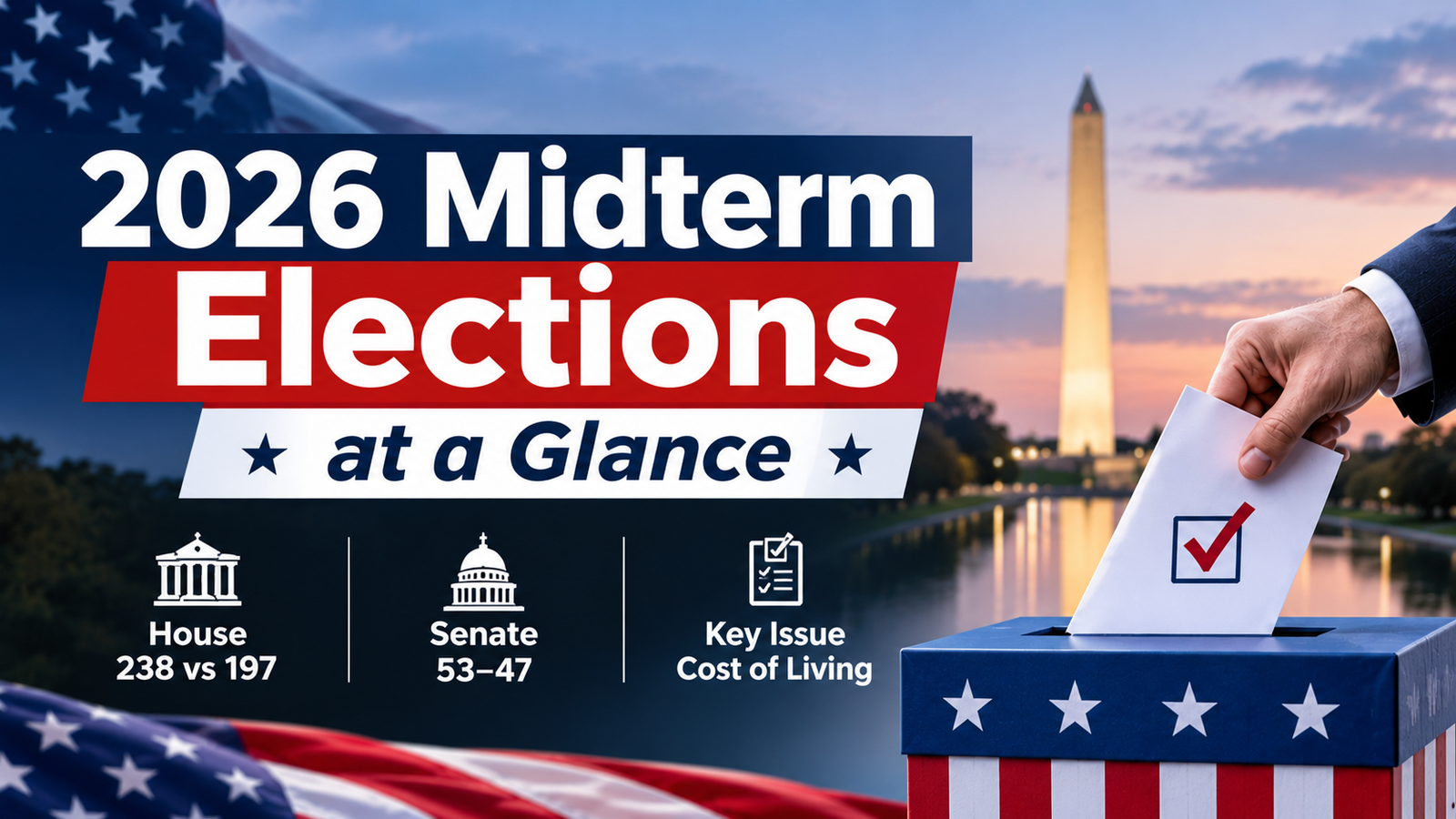
| Question | Current picture |
|---|---|
| Who controls the House? | Republicans hold a very narrow advantage |
| Who controls the Senate? | Republicans hold a 53-seat majority |
| How many House seats are contested? | All 435 |
| How many regular Senate seats are contested? | 33, plus two special elections |
| Which chamber is easier for Democrats to flip? | The House |
| How many Senate seats must Democrats gain? | A net four, assuming the current caucus alignment |
| Major political issue | Cost of living and the economy |
| Other major issues | Energy, immigration, abortion, foreign policy and Trump |
| Why does it matter? | Congressional control will determine how much power either party has through 2028 |
Current congressional numbers and battleground classifications are tracked in detail by Ballotpedia’s 2026 congressional election overview.
1. What Are the Midterm Elections?
The midterm elections take place halfway through a four-year presidential term.
The presidency itself is not being contested.
Instead, Americans decide who controls Congress and thousands of state and local offices.
Every seat in the House of Representatives is contested because House members serve two-year terms.
Only around one-third of the Senate normally faces election in any one cycle because senators serve six-year terms.
That structure creates an important political dynamic.
A president can enter office with enough congressional support to pass major legislation, then lose that advantage two years later.
Midterms are therefore frequently treated as a national judgment on the sitting president.
Historically, the president’s party usually loses congressional seats in midterm elections. Reuters notes that over the past eight decades, the president’s party has managed congressional gains in only a small number of midterm cycles.
That historical pattern makes 2026 particularly uncomfortable for Republicans.
2. The House Could Be the Biggest Battle
The House is where control of Washington may change most easily.
Republicans currently hold only a narrow advantage.
Ballotpedia’s current breakdown lists 218 Republicans, 214 Democrats, one independent who caucuses with Republicans, and two vacancies.
That means Democrats need only a small net gain to take control.
See Ballotpedia’s House battleground analysis.
This is why individual suburban and swing districts matter so much.
A few seats in Pennsylvania, Michigan, New York, Wisconsin, Ohio or other competitive states could determine which party controls the chamber.
Ballotpedia has identified dozens of House districts as battlegrounds.
That creates a very different election from one in which a party begins with a comfortable 30- or 40-seat majority.
In 2026, a relatively small political movement could be enough to change national power.
What would a Democratic House mean?
If Democrats gain control, they could:
- block or rewrite Republican legislation
- control House committees
- launch investigations
- issue subpoenas
- scrutinize Trump administration agencies
- control the House legislative calendar
It would not remove Trump from office.
But it would sharply reduce the administration’s freedom to govern through Congress.
3. The Senate Is Much Harder for Democrats
The Senate presents a different challenge.
Republicans hold 53 seats.
Democrats hold 45, while two independents caucus with them.
That effectively gives the Democratic side 47 votes.
Democrats therefore need a net gain of four seats to gain a Senate majority under the present alignment.
Ballotpedia is tracking a dozen Senate contests as battlegrounds.
Among the most closely watched states are:
- Alaska
- Georgia
- Iowa
- Kansas
- Maine
- Michigan
- Nebraska
- New Hampshire
- Ohio
- Texas
Some of those races would normally be considered relatively safe for one party.
That they are competitive illustrates how unusual the political environment has become.
Texas, for example, has developed into a major contest between Republican Ken Paxton and Democrat James Talarico.
Michigan is another crucial battlefield, with Democrat Abdul El-Sayed facing Republican Mike Rogers.
The Senate is therefore possible for Democrats, but substantially harder than the House.
4. The Election Is Becoming a Referendum on Trump
Donald Trump is not on the congressional ballot.
Politically, however, he is everywhere.
The 2026 midterm elections are increasingly functioning as a referendum on his second presidency.
That creates both advantages and dangers for Republicans.
Trump remains extraordinarily influential among Republican voters.
His ability to mobilize supporters can help candidates who need strong conservative turnout.
But a midterm electorate also contains voters who may use their congressional vote specifically to limit presidential power.
A late-October Reuters/Ipsos poll found Trump’s approval at 32%.
Among registered voters, Democrats held a significant advantage on the generic congressional ballot, although the precise margin varied depending on how undecided voters were treated.
Generic-ballot polling does not predict every district.
The geography of House and Senate elections matters enormously.
Still, the national numbers explain why Republicans are fighting defensively in places that would normally be more comfortable.
This also connects to a wider political shift Signature Views has explored in its coverage of how modern political leaders increasingly depend on digital narratives and algorithm-driven campaigning.
Read: How AI-Powered Social Media Strategies Shape Political Narratives and Influence
5. Cost of Living May Matter More Than Ideology
Campaigns produce arguments about immigration, abortion, foreign affairs and cultural issues.
But one issue repeatedly cuts across political identity:
Can people afford everyday life?
Reuters/Ipsos found that 73% of respondents believed the cost of living was moving in the wrong direction in late October.
That is politically dangerous for the party controlling the White House.
Voters encounter the economy through:
- grocery prices
- gasoline
- electricity
- rent
- mortgages
- insurance
- borrowing costs
They do not necessarily separate global forces from presidential policy.
If gasoline rises because of geopolitical disruption, many voters still blame the government currently in power.
If electricity bills rise because of grid investment, natural-gas prices or data-center demand, the political impact can still land on incumbents.
That helps explain why affordability has become one of the central themes of the midterm elections 2026.
Economic uncertainty also connects to wider global instability. Signature Views has covered similar links between geopolitics, energy and household costs in its recent international analysis.
Russia Ukraine Energy Ceasefire
6. Energy Has Become a Political Issue
Energy might normally sound like a specialist policy debate.
In 2026 it has become a household issue.
Higher gasoline and electricity costs are affecting competitive states.
Reuters reported that in several battleground states, household spending on electricity and gasoline rose substantially during 2026, putting additional pressure on voters already worried about inflation.
Candidates therefore argue about:
- domestic oil production
- renewable energy
- natural gas
- electricity grids
- environmental regulation
- data-center power consumption
- foreign wars affecting energy supplies
This makes energy policy unusually important in the US midterm elections.
It also demonstrates how foreign policy can become domestic politics.
A conflict thousands of miles away can increase energy prices, which then influence a House race in Pennsylvania or a Senate contest in Texas.
7. Immigration and Abortion Still Divide the Electorate
The economy may dominate, but it is not the only major issue.
Immigration
Republicans continue to emphasize:
- border security
- illegal immigration
- deportation
- enforcement
- citizenship and election-security concerns
Democrats have attacked parts of the administration’s immigration approach as excessive or legally questionable.
The political effect varies by state and demographic group.
Abortion
Abortion remains particularly important because the issue is increasingly decided through states, courts and elections following the end of the federal constitutional protection established under Roe v. Wade.
Democrats generally see abortion rights as an issue capable of mobilizing younger voters and suburban women.
Republicans remain divided between candidates emphasizing strict abortion restrictions and those seeking more politically moderate positions.
These issues may not determine every race, but in close elections even a small turnout or persuasion effect can matter.
8. A Few Senate Races Could Decide Everything
The national vote total does not determine Senate control.
Individual states do.
That makes several races disproportionately important.
Ballotpedia’s late-October list of major races includes Senate contests in Alaska, Georgia, Iowa, Kansas, Maine, Michigan, Nebraska, New Hampshire, Ohio and Texas.
Georgia and Michigan are especially important for Democrats because they are defending seats in states Trump won in 2024.
Maine presents the reverse situation: Republicans are defending a seat in a state that backed Kamala Harris in the 2024 presidential race.
Texas has become particularly symbolic.
A Democratic Senate victory there would represent a major political breakthrough in a state Republicans have dominated at the statewide level for decades.
But Democrats do not need symbolic wins.
They need arithmetic.
Without enough net Senate gains, even a strong national Democratic performance could leave Republicans controlling the chamber.
9. The Midterms Could Start the 2028 Presidential Race
The election is ostensibly about Congress.
Politically, it is also the unofficial beginning of 2028.
Trump cannot dominate American electoral politics forever.
Both parties are already asking what comes next.
For Republicans, the question is whether Trump’s coalition can survive without Trump himself as the presidential candidate.
Vice President JD Vance and Secretary of State Marco Rubio are among the figures whose standing could be affected by the midterm result.
A Republican victory would strengthen arguments for continuity.
A major defeat could trigger an internal debate over whether Trump-style politics remains electorally sustainable.
Democrats face their own argument.
Should the party move toward a more populist economic message?
Should it remain close to its current establishment leadership?
Should younger progressive candidates play a larger role?
AP describes the election as a crossroads for both parties as attention begins shifting toward the post-Trump political era.
That may ultimately be the election’s biggest long-term consequence.
What Happens if Democrats Win the House but Not the Senate?
This may be one of the more plausible divided-government scenarios.
A Democratic House could:
- investigate the administration
- block Republican legislation
- complicate budget negotiations
- challenge White House priorities
But a Republican Senate could continue influencing:
- federal judicial confirmations
- executive appointments
- Senate legislation
The result would likely be more institutional conflict and fewer major laws.
What Happens if Democrats Win Both Chambers?
A Democratic sweep would dramatically constrain Trump.
Congress could block much of his legislative program and increase oversight of the executive branch.
But Democrats would still face one major limit:
Trump would remain president.
Congress cannot simply enact its own agenda over a presidential veto without the constitutionally required supermajorities.
A Democratic Congress would therefore be better described as a powerful brake on Trump than a replacement government.
What Happens if Republicans Keep Congress?
Republican control of both chambers would be interpreted as a major political victory for Trump.
It could allow Republicans to continue pursuing:
- tax policy
- spending priorities
- immigration legislation
- energy policy
- deregulation
- administration appointments
It would also strengthen Trump’s influence over the Republican Party heading toward 2028.
Why the 2026 Midterm Elections Matter Beyond America
The consequences will not stop at the U.S. border.
Congress influences:
- military spending
- foreign aid
- sanctions
- trade policy
- NATO
- Ukraine
- the Middle East
- China policy
- technology regulation
A change in congressional control could therefore affect governments, markets and conflicts around the world.
That makes the 2026 elections relevant even to people who cannot participate in them.
Signature Views’ recent coverage of the Falkland dispute and the growing role of U.S. diplomatic leverage illustrates how decisions made in Washington can quickly influence disputes far outside North America.
The Bottom Line
The 2026 midterm elections may be decided by surprisingly small margins.
Republicans enter the final stage with control of both chambers, but neither advantage is untouchable.
The House could change hands with only a modest shift.
The Senate requires Democrats to win a much more demanding collection of state races.
And underneath the seat-by-seat mathematics is a larger question.
What do Americans think of Trump’s second presidency?
For Republicans, the election is a test of whether the coalition that returned Trump to power can survive economic frustration and the normal midterm backlash against an incumbent president.
For Democrats, it is a test of whether dissatisfaction can be converted into congressional power.
For both parties, the results will shape the struggle over what comes after Trump.
That is why these midterms matter far beyond a few dozen competitive congressional districts.
They could decide whether the final two years of Trump’s presidency are defined by legislative power or divided government, and they may determine which political movement enters the 2028 presidential race with momentum.
Frequently Asked Questions About the 2026 Midterm Elections
What are the midterm elections?
Midterm elections are congressional and state elections held halfway through a U.S. president’s four-year term. The presidency itself is not being contested.
Why are the 2026 midterm elections important?
They determine which party controls Congress during the second half of Donald Trump’s current presidential term.
Is the House or Senate more likely to change control?
The House requires a smaller net shift and is therefore generally viewed as more vulnerable. The Senate presents a more difficult path for Democrats.
How many House seats are involved?
All 435 voting House districts are part of the congressional election cycle.
How many Senate seats are involved?
There are 33 regularly scheduled Senate contests, along with two special elections in the 2026 cycle.
What are the biggest issues in the midterm elections 2026?
The leading issues include the cost of living, energy prices, immigration, abortion, foreign policy and perceptions of President Trump’s performance.
Are the 2026 midterms a referendum on Trump?
Not formally, but politically they are widely being treated as one. Presidents typically influence their party’s midterm performance even when they are not candidates themselves.
About the Author